MCQ
$Br_2 + 2{X^-}_{aq} \to X_2 + 2{Br^-}_{aq}$ above reaction is correct when $X^-$ is :
  • A
    $F^-, Cl^-$
  • $I^-$ only
  • C
    $F^-, Cl^-, I^-$
  • D
    Not possible for any halide

Answer

Correct option: B.
$I^-$ only
b
Concentrated $H _2 SO _4$ cannot be used to prepare $HBr$ from $NaBr$ because it oxidises $HBr$ to $Br _2$.

Need a full question paper?

Generate a complete, print-ready paper with questions like this in minutes — across 16+ boards, with answer keys.

Start Generating Free

Similar questions

An octahedral complex with molecular composition $M.5\, NH_3.Cl.SO_4$ has two isomers, $A$ and $B$. The solution of $A$ gives a white precipitate with $AgNO_3$ solution and the solution of $B$ gives white precipitate with $BaCl_2$ solution. The type of isomerism exhibited by the complex is
Which of the following plot does not represent the behaviour of an ideal binary liquid solution of A and B?
The first transition element is
Glycol on treatment with $PI_3$ mainly gives -
$1.86\, g$ of aniline completely reacts to form acetanilide. $10 \,\%$ of the product is lost  during purification. Amount of acetanilide obtained after purification (in $g$) is ...... $\times 10^{-2}.$
$1\, \mathrm{~kg}$ of $0.75$ molal aqueous solution of sucrose can be cooled up to $-4^{\circ} \mathrm{C}$ before freezing. The amount of ice (in $g$) that will be separated out is .... . (Nearest integer)

$\left[\right.$ Given $\left.: \mathrm{K}_{\mathrm{f}}\left(\mathrm{H}_{2} \mathrm{O}\right)=1.86\, \mathrm{~K}\, \mathrm{~kg}\, \mathrm{~mol}^{-1}\right]$

Which of the following will not act as oxidising agents?
The Freezing point of $1\%$ aqueous solution of calcium nitrate will be
Semipermeable membrane allows :
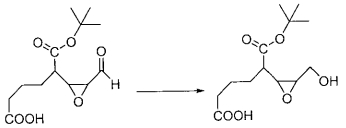
Reagent($s$) which can be used to bring about the following transformation is(are)

($A$) $\mathrm{LiAlH}_4$ in $\left(\mathrm{C}_2 \mathrm{H}_5\right)_2 \mathrm{O}$

($B$) $\mathrm{BH}_3$ in $THF$

($C$) $\mathrm{NaBH}_4$ in $\mathrm{C}_2 \mathrm{H}_5 \mathrm{OH}$

($D$) Raney $\mathrm{Ni} / \mathrm{H}_2$ in $\mathrm{THF}$