Question
Briefly describe the following term giving one example:
Polyolefins.

Answer

Polyolefins: These are polymers derived from unsaturated hydrocarbons, for example, polypropene.

Need a full question paper?

Generate a complete, print-ready paper with questions like this in minutes — across 16+ boards, with answer keys.

Start Generating Free

Similar questions

Draw the structures of the following:
  1. $XeF_4$
  2. $HClO_4$
Write the structures of monomers used in the preparation of:
  1. Teflon.
  2. PMMA.
Write structures of different dihalogen derivatives of propane.
Complete the following chemical reaction equations:
  1. $XeF_2 + H_2O →$
  2. $PH_3 + HgCl_2 →$
Define an ideal solution and write one of its characteristics.
A primary amine, $RNH_2$ can be reacted with $CH_3-X$ to get secondary amine, $R-NHCH_3$ but the only disadvantage is that $3^\circ$ amine and quaternary ammonium salts are also obtained as side products. Can you suggest a method where $RNH_2$ forms only $2^\circ$ amine?
Compound $‘A’$ with molecular formula $C_4H_9Br$ is treated with aq. $KOH$ solution. The rate of this reaction depends upon the concentration of the compound ‘A’ only. When another optically active isomer $‘B’$ of this compound was treated with aq. $KOH$ solution, the rate of reaction was found to be dependent on concentration of compound and $KOH$ both.
  1. Write down the structural formula of both compounds $‘A’$ and $‘B’.$
  2. Out of these two compounds, which one will be converted to the product with inverted configuration.
Why the tansition element form a large number of complex compounds ?
Vapour pressure of pure water at $298$ K is $23.8$ mm Hg. $50$ g of urea $(NH_2CONH_2)$ is dissolved in $850$ g of water. Calculate the vapour pressure of water for this solution and its relative lowering.

Match the reactions given in Column I with the names given in Column II.
  Column I   Column II
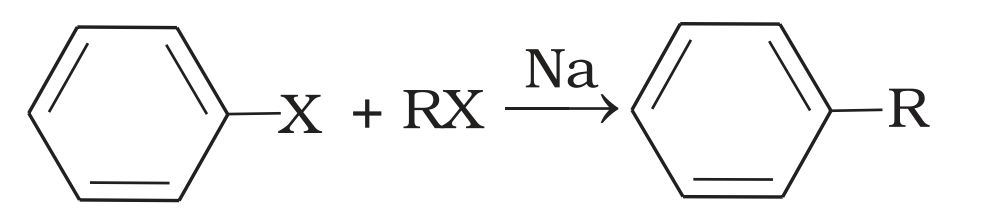
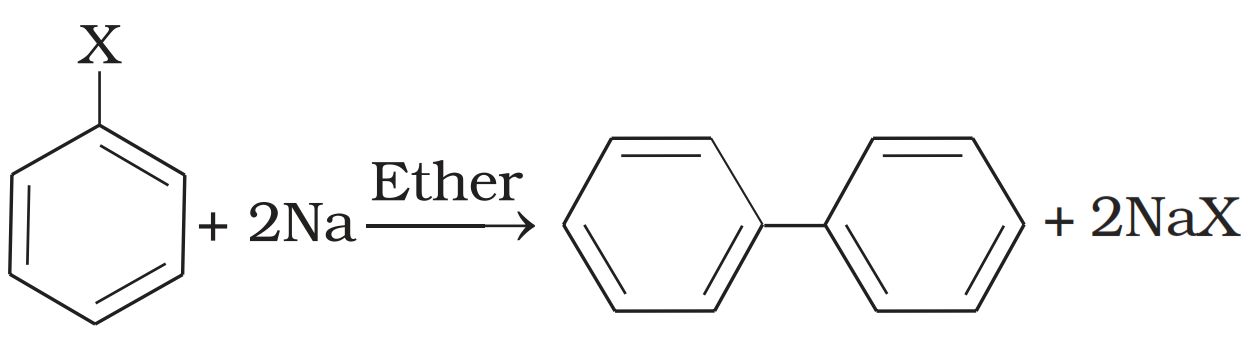
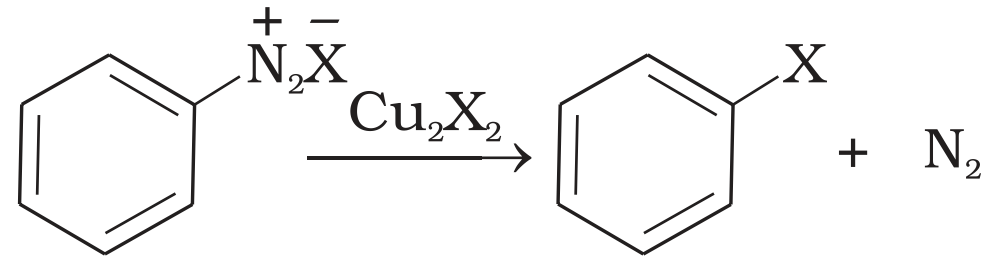
(i) (a) Fittig reaction
(ii) (b) Wurtz Fittig reaction
(iii) (c) Finkelstein reaction
(iv) (d) Sandmeyer reaction