Question
Briefly describe the following: Transcription

Answer

Transcription: Genetic informations are transferred from DNA to RNA. The process of synthesis of RNA from DNA is called transcription. DNA directs the synthesis of proteins. This DNA is found in nucleotide of prokaryotic cells and nucleus of eukaryotic cells. DNA molecules never leave their place and therefore DNA molecules code the messages of protein synthesis in mRNA which carries the message from nucleus to cytoplasm over ribosome therefore the synthesis of RNA on DNA template is called transcription. When mRNA is synthesized on DNA template, it contains Uracil in place of Thymine. This synthesis occurs in presence of enzyme RNA polymerase.
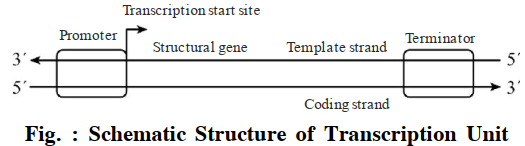
A segment of DNA that transcripts the RNA, is called Transcriptional unit. This unit may be like a gene or may have many continuous genes. There are three main components of transcriptional unit in DNA:
(1) Promoter,
(2) Structural gene,
(3) Terminator
DNA dependent RNA polymerase catalyses the polymerization in only one direction i.e. 5'→3'. The strand with 3'→5' polarity serves as template and is therefore, called template strand.
Image

The promoter and terminator flank the structural gene in a transcription unit. The promoter is said to be located towards S'-end (upstream) of the structural gene (the reference is made with respect to the polarity of coding strand). It is a DNA sequence that provides binding site for RNA polymerase, and it is the presence of a promoter in a transcription unit that also defines the template and coding strands. The terminator is located towards 3'-end (downstream) of the coding strand and it usually defines the end of the process of transcription. There are additional regulatory sequences that may be present further upstream or downstream to the promoter.

Need a full question paper?

Generate a complete, print-ready paper with questions like this in minutes — across 16+ boards, with answer keys.

Start Generating Free

Similar questions

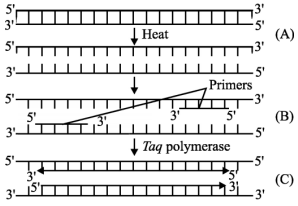
The melding of a technique for repeated rounds of DNA synthesis with the discovery of a thermostable DNA polymerase has given scientists the very powerful technique known as polymerase chain reaction (PCR). PCR is based on three simple steps required for any DNA synthesis reaction: (1) denaturation of the template into single strands; (2) annealing of primers to each original strand for new strand synthesis; and (3) extension of the new DNA strands from the primers.
In the given figure, one cycle of polymerase chain reaction (PCR) is shown:
Image
i. Name the steps A, B and C.
ii. Give the purpose of each of these steps.
iii. State the contribution of Thermus aquaticus in this process.
State the similarity and differences between geitonogamy and xenogamy. Why do cleistogamous flowers assure seed sets?
Answer the following questions:
State and explain the law of segregation as proposed by Mendel in a monohybrid cross.
  1. Give reasons for:
  1. Both strands of DNA are not copied during transcription.
  2. Transcription and translation in bacteria can be coupled.
  1. Differentiate between the process of transcription in prokaryotes and eukaryotes.
Trace the origin and evolution of Man.
Explain the different ways of diagnosing cancer.
What is post-fertilization event? Describe the structure of plant endosperm. Also draw a well labelled diagram of dicot embryo.
Draw a diagrammatic sketch of the sectional view of a typical anatropous ovule.

OR

Draw a labelled diagram of the sectional view of a typical anatropous ovule.

Write the conclusions Mendel arrived at on dominance of traits on the basis of monohybrid crosses that he carried out in pea plants.
Restriction enzymes are found in bacteria (and other prokaryotes). They recognize and bind to specific sequences of DNA, called restriction sites. Each restriction enzyme recognizes just one or a few restriction sites.
When it finds its target sequence, a restriction enzyme will make a double-stranded cut in the DNA molecule.
i. Write the palindromic nucleotide sequence for the following DNA segment.
5'-GAATTC-3'
ii. Name the restriction endonuclease that recognises this sequence.
iii. How are sticky ends produced? Mention their role.