Question
Briefly describe the following: Translation

Answer

Translation: The formation of a poly-peptide chain from m-RNA is known as Translation. All three types of RNAs named m-RNA, r-RNA and t-RNA participate in this process. The process of translation takes place on ribosome. The sequence of three nitrogen bases present in 5-3 direction on m-RNA is called genetic code. This code determines the sequence of amino acids in a poly-peptide chain. t-RNA has anticodon which brings specific amino acid from cytoplasm tom-RNA and this entire process requires energy provided by ATP.
The process of translation is completed in following steps:
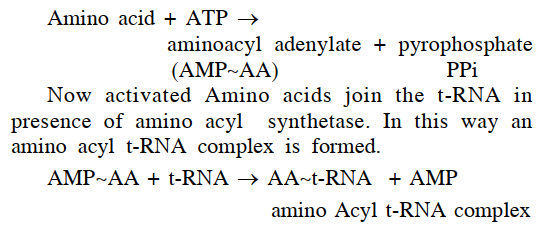
Activation of amino acids: All the 20 types of amino acids are present in cytoplasm in inactive state but before joining to t-RNA, amino acids become active to react with ATP in presence of $Mg ^{++}$ and amino acyl t-RNA synthetase. The activated amino acids are called amino acyl adenylate.
Image
Involvement of Ribosome: Ribosomes are composed of Protein and r-RNA. These ribosomes are made of two dissimilar (smaller and bigger) subunits which join together at the time of protein synthesis along with m RNA. Many ribosomes unite together forming Polyribosome which takes part in this process.
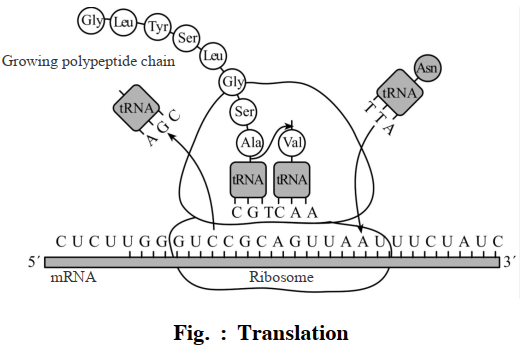
Initiation of poly-peptide chain formation: Each poly-peptide chain always begins with meithionine amino acid. This amino acid is coded by initiating codon AUG. The t-RNA possessing this amino acid has anti codon UAC. Therefore t-RNA with anti-codon UAC and activated methionine amino acid joins the m-RNA with codon AUG and initiates the synthesis of poly-peptide chain. This process requires the GTP bound with bigger sub-unit of ribosome and initiation factors like $IF _1$, $IF _2$ and $IF _3$ During translation, m RNA contains the sequences which has initiation codon AUG at one end and termination codon at other end. Ribosome binds at 5' end of m RNA and translates codons in m RNA on moving towards 3' end. m-RNA has some additional sequences which are not translated such sequences are said to be untranslated region or UTR. These UTR are very essential for effective translation and are situated before initiation. codon at 5' and after terms nation codon at 3'.
Formation and elongation of poly-peptide chain:
Amino acid in poly-peptide chain are joined together by peptide linkage. This linkage is formed between carboxyl group (-COOH) of one amino acid and an amine group $\left(- NH _2\right)$of next amino acid. The carboxyl group of chain initiating amino acid meithionine remains free to form linkage with - $- NH _2$group of next amino acid.
Now the next activated t-RNA with an appropriate anticodon (that is complementary to codon of m RNA) and amino acid combines with the code of m RNA at A-site. Peptide-linkage is formed between successive amino acids in presence of peptidyl transferase m-RNA moves forward at P site/D-site and A site is occupied by new codon. Now next t-RNA molecule with amino acid reaches the A Site and repeats the same process resulting in elongation of poly peptide chain. The shifting of m RNA from A-site to P-site is called translocation.
Image
Termination of poly peptide chain: The elongation continues till the whole m RNA is translated and a signal in the form of termination codon is reached for which t-RNA has no anticodon such codon are called nonsense codon or stop codon or termination cordons e.g. UAA, UAG and UGA Releasing factors $R _2$ and $R _3$ are helpful in this process which makes polypeptide chain to be free. After becoming free, polypeptide chain undergoes some changes. Enzyme formylase separates the former group of first-amino acid methionine. Some amino acid can be removed from beginning or ending side of chain. After this chain becomes folded to form secondary or tertiary structure. This entire process takes energy from GTP.

Need a full question paper?

Generate a complete, print-ready paper with questions like this in minutes — across 16+ boards, with answer keys.

Start Generating Free

Similar questions

Draw a diagrammatic sketch of the sectional view of a typical anatropous ovule.

OR

Draw a labelled diagram of the sectional view of a typical anatropous ovule.

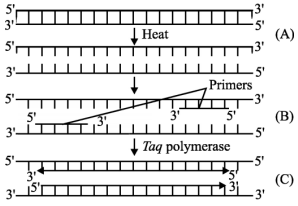
The melding of a technique for repeated rounds of DNA synthesis with the discovery of a thermostable DNA polymerase has given scientists the very powerful technique known as polymerase chain reaction (PCR). PCR is based on three simple steps required for any DNA synthesis reaction: (1) denaturation of the template into single strands; (2) annealing of primers to each original strand for new strand synthesis; and (3) extension of the new DNA strands from the primers.
In the given figure, one cycle of polymerase chain reaction (PCR) is shown:
Image
i. Name the steps A, B and C.
ii. Give the purpose of each of these steps.
iii. State the contribution of Thermus aquaticus in this process.
Drugs like LSD, barbiturates, amphetamines, etc., are used as medicines to help patients with mental illness. However, excessive doses and abusive usage are harmful. Enumerate the major adverse effects of such drugs in humans.
During the reproductive cycle of a human female, when, where and how does a placenta develop? What is the function of placenta during pregnancy and embryo development?
One chromosome contains one molecule of DNA. In eukaryotes the length of the DNA molecule is enormously large. Explain how such a long molecule fits into the tiny chromosomes seen at metaphase.
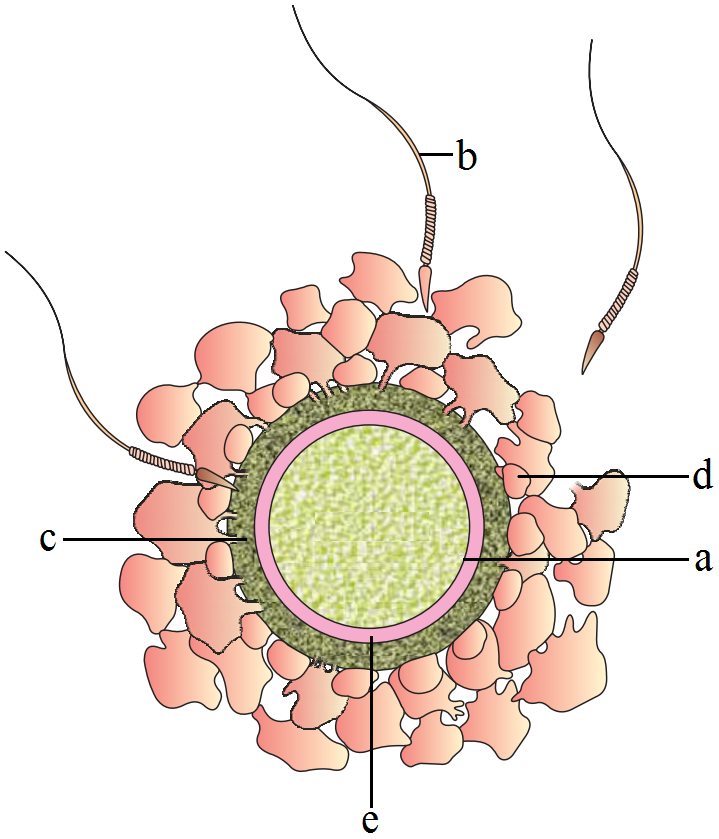
Study the illustration given and answer the questions that follow:

Identify ‘a’.

Draw a neat diagram of the female reproductive system and label the parts associated with the following.
  1. Production of gamete.
  2. Site of fertilisation.
  3. Site of implantation.
  4. Birth canal.
Write notes on ex-situ conservation of biodiversity
Define ecological pyramids and describe with examples, pyramids of number and biomass.
What do you understand by micro proagation? Write the methods involved with suitable diagrams.###(a) What are the plants raised through the micropropagation termed as somaclones?
(b) Mention two advantages of this technique.