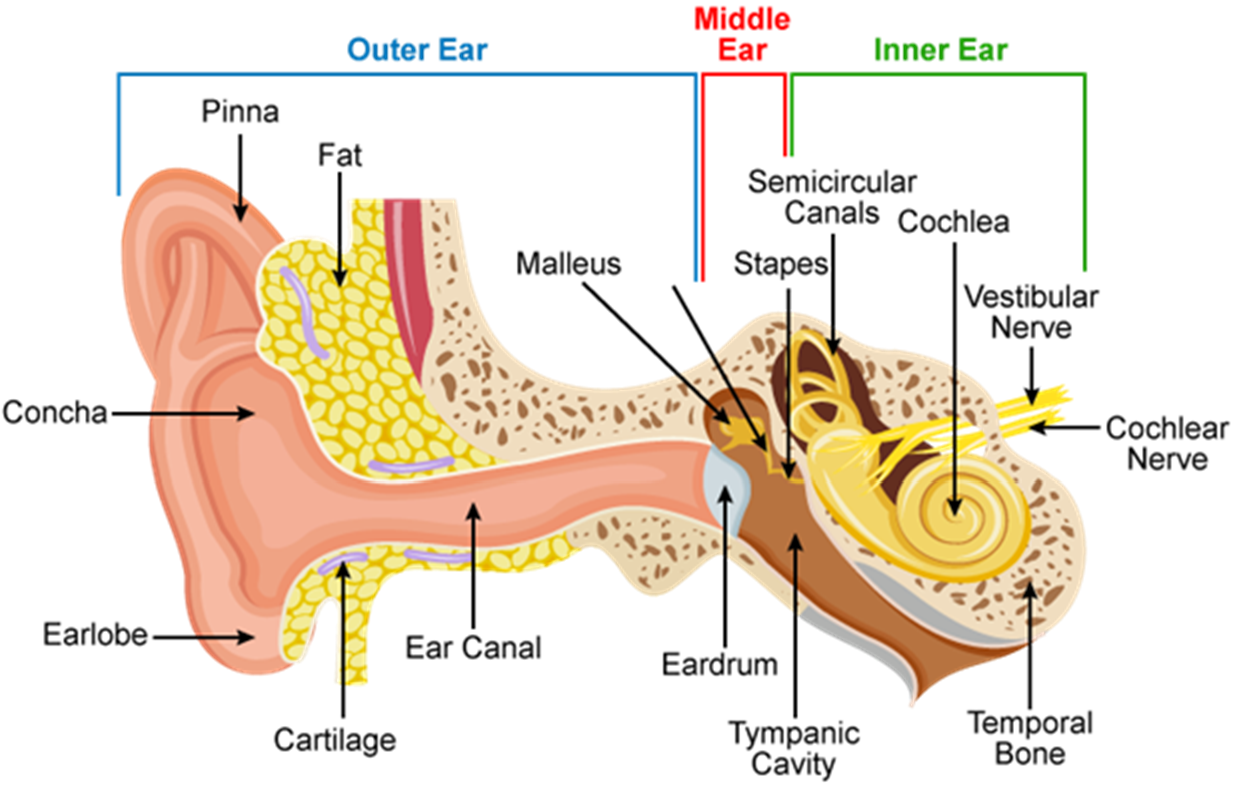
Ear: Ear is the sense organ for hearing and equilibrium. It consists of three portions – external ear, middle ear, and internal ear.
- External ear:
It consists of pinna, external auditory meatus, and a tympanic membrane.
- Pinna is a sensitive structure that collects and directs the vibrations into the ear to produce sound.
- External auditory meatus is a tubular passage supported by cartilage in external ear.
- Tympanic membrane is a thin membrane that lies close to the auditory canal. It separates the middle ear from external ear.
- Middle ear:
It is an air-filled tympanic cavity that is connected with pharynx through eustachian tube. Eustachian tube helps to equalize air pressure in both sides of tympanic membrane. The middle ear contains a flexible chain of three middle bones called ear ossicles. The three ear ossicles are malleus, incus, and stapes that are attached to each other.
- Internal ear:
It is also known as labyrinth. Labyrinth is divided into bony labyrinth and a membranous labyrinth. Bony labyrinth is filled with perilymph while membranous labyrinth is filled with endolymph. Membranous labyrinth is divided into 2 parts.
- Vestibular apparatus:
Vestibular apparatus is a central sac-like part that is divided into utriculus and sacculus. A special group of sensory cells called macula are present in sacculus and utriculus.
Vestibular apparatus also contains three semi-circular canals. The lower end of each semi-circular canal contains a projecting ridge called crista ampularis. Each ampulla has a group of sensory cells called crista. Crista and macula are responsible for maintaining the balance of body and posture. - Cochlea:
Cochlea is a long and coiled outgrowth of sacculus. It is the main hearing organ. Cochlea consists of three membranes. The organ of corti, a hearing organ, is located on the basilar membrane that has hair cells.