Question
Briefly explain IVF and ET What are the conditions in which these methods are advised?

Answer

IVF stands for in-vitro fertilization. In this technique, sperm from the male (or donor) and ovum from the female (or donor) are taken out. Ovum is then fertilized in the laboratory; usually in a petri dish. ET stands for embryo transfer and is the next procedure after IVF. Embryo up to 8 blastomere stage is transferred in the fallopian tube. Embryo with more than 8 blastomeres is transferred to the uterus. Since, the technique involves carrying out fertilization and some development of zygote in the laboratory hence babies born out of this method are often called test tube babies. These methods are parts of Assisted Reproductive Technologies (ART). These methods are employed when medical treatment and psychotherapy may have failed in helping the couple in conception. These methods require very high degree of precision and can only be carried out by highly specialized doctors. Moreover, employing these technologies require costly equipments. Hence, facilities for IVF or ET are available only at select centres across the country.
Need a full question paper?

Generate a complete, print-ready paper with questions like this in minutes — across 16+ boards, with answer keys.

Start Generating Free

Similar questions

Kanchan went to a garden and saw some flowers which were closed. She assumed that those flowers must be buds. But she was astonished to see that all the flowers of that plant were closed and none of them was open. She was confused and asked her queries to her teacher.
  1. What do you think, are there any plants with closed flowers? Give an example.
  2. Are such plants get pollinated? Explain.
  3. What are such flowers/ plants called?
  4. What values are shown by Kanchan?
What is parturition? Which hormones are involved in induction of parturition?
Why did T.H. Morgan select Drosophila melanogaster to study sex linked genes for his lab experiments?
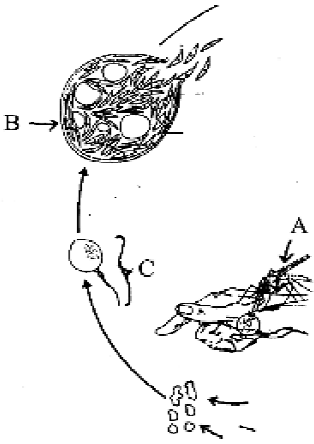
Study a part of the life cycle of malarial parasite given below. Answer the questions that follow:

  1. Mention the roles of ‘A’ in the life cycle of the malarial parasite.
  2. Name the event ‘C and the organ where this event occurs.
  3. Identify the organ ‘B’ and name the cells being released from it.
The base sequence on one of the strands of DNA is ATGTCTATA.
  1. Give the base sequence of its complementary strand.
  2. If an RNA strand is transcribed by this strand, what would be the base sequence of RNA?
  3. In what other respect, an RNA molecule differs from a DNA molecule?
  1. "Organisms may be conformers or regulators." Explain this statement and give one example of each.
  2. Why are there more conformers than regulators in the animal world?
Biodiversity plays a key role in many ecosystem services provided by nature.
(a) Present any two widely useful arguments to prove the validity of the statement.
(b) Write any one moral reason for protecting biodiversity.
Explain the following two components of Darwin's theory of natural selection.
  1. Variations.
  2. Formation of new species.
The following table shows the genotypes for ABO blood grouping and their phenotypes. Fill in the gaps left in the table.
S. No.
Genotype
Blood group
i.
IA IA
A
ii.
_________________
A
iii.
IB IB
B
iv.
________________
B
v.
IA IB
_______________
vi.
_________________
O
  1. What are the transcriptional products of RNApolymerase III?
  2. Differentiate between 'Capping' and 'Tailing'.
  3. Expand hnRNA.