Question
Briefly explain Rutherford's nuclear model.

Answer

In 1906, Rutherford suggested a brilliant experiment involving the scattering of $\alpha$-particles by atoms to understand the structure of atoms.
This experiment was later performed around 1911 by Geiger and Marsden.
The results of these experiments revealed that the model of the atom resembles the model of the sun and the planets.
According to this model, the entire positive charge and almost all the mass of the atom is concentrated in a small volume called the nucleus with the electrons revolving around the nucleus just like planets revolve around the sun.
Rutherford's atomic model cannot explain the following points.
(i) Why atoms emit light of only certain (discrete) wavelengths ?
(ii) A very simple atom like hydrogen consisting of a single electron and proton, how does it give a complex spectrum of specific wavelengths ?

Need a full question paper?

Generate a complete, print-ready paper with questions like this in minutes — across 16+ boards, with answer keys.
Start Generating Free

Similar questions

Define electric field strength. Is it a vector or a scalar quantity?
Explain series connection of cells. Derive the formula for equivalent emf and equivalent internal resistance for series connection of cell.
It is said that a liquid rises or is depressed in a capillary due to the surface tension. If a liquid neither rises nor depresses in a capillary, can we conclude that the surface tension of the liquid is zero?
Write the formula for the torque acting on a current$-$carrying coil placed in uniform magnetic field and explain its stable and unstable equilibrium states.
If the bar magnet in Q. 58 is turned around by 180°, where will the new null points be located?
The distance of the field point on the axis of a small dipole is doubled. By what factor will the electric field, due to the dipole change?
Show that the radius of the orbit in hydrogen atom varies as n2, where n is the principal quantum number of the atom.
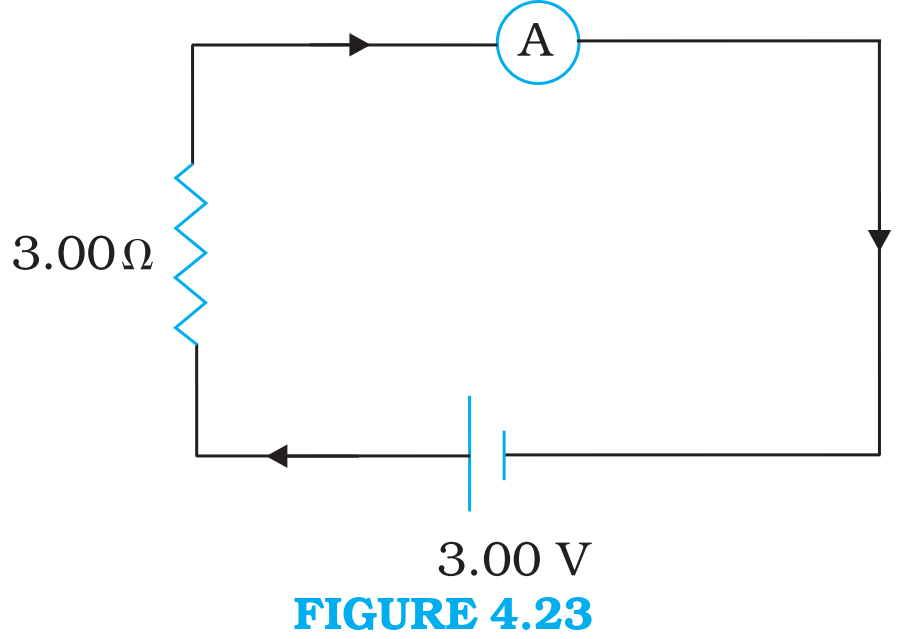
In the circuit (Fig. 4.23) the current is to be measured. What is the value of the current if the ammeter shown (a) is a galvanometer with a resistance $R_G=60.00 \Omega$; (b) is a galvanometer described in (a) but converted to an ammeter by a shunt resistance $r_s=0.02 \Omega$; (c) is an ideal ammeter with zero resistance?
Image
Complete the following decay schemes.
  1. $\text{ }^{226}_{88}\text{Ra}\rightarrow\alpha+$
  2. $\text{ }^{19}_8\text{O}\rightarrow\text{ }^{19}_9\text{F}+$
  3. $\text{ }^{25}_{13}\text{Al}\rightarrow\text{ }^{25}_{12}\text{Mg}+$
Answer the following questions:
An applied voltage signal consists of a superposition of a dc voltage and an ac voltage of high frequency. The circuit consists of an inductor and a capacitor in series. Show that the dc signal will appear across C and the ac signal across L.