Question
Briefly explain the discovery of neutrons.

Answer

Neutron was discovered by a scientist named Chadwick.
Chadwick observed emission of neutral radiation when beryllium nuclei were bombarded with $\alpha$-particle. ( $\alpha$-particle is made up of a helium nucleus)
In addition he observed that this neutral radiation could knock out protons from light nuclei such as those of helium, carbon and nitrogen.
The only neutral radiation known at that time was photons. (electromagnetic radiation)
Application of the principles of conservation of energy and momentum showed that if the neutral radiation consisted of photons, the energy of photons would have to be much higher than is available from the bombardment of beryllium nuclei with $\alpha$-particles.
From conservation of energy and momentum, the mass of new particle (neutron) was found to be as very nearly the same as mass of proton.
Currently, the mass of neutron
$m_n=1.00866 u=1.6749 \times 10^{-27} kg$
Chadwick was awarded the 1935 Nobel prize in physics.
A free neutron, unlike a free proton is unstable.

Need a full question paper?

Generate a complete, print-ready paper with questions like this in minutes — across 16+ boards, with answer keys.

Start Generating Free

Similar questions

A parallel plate capacitor is charged with a potential difference 50 V . Thereafter it is discharged by a resistor for 2 sec , due to which its potential decreases by 10 V . Calculate the portion of energy stored in the capacitor.
Two thin lenses of powers 5D and 2D are placed coaxially at a distance 20 cm apart. Find the focal length and power of the combination of lenses.
Write applications of the resonance phenomenon in the $L - C - R$ series circuit.
While gas from a cooking gas cylinder is used, the pressure does not fall appreciably till the last few minutes. Why?
A hydrogen atom in a state having a binding energy of 0.85eV makes transition to a state with excitation energy 10.2eV (a) Identify the quantum numbers n of the upper and the lower energy states involved in the transition. (b) Find the wavelength of the emitted radiation.
The distance between the two plates of a parallel plate capacitor is 4 mm . A 3 mm thick dielectric strip having dielectric constant 3 is placed between the plates parallel to the plates. The distance between the plates is arranged in such a way that the capacitance of the capacitor becomes $2 / 3$ of the initial capacitance. What is the new distance between the plates?
Find the maximum potential difference which may be applied across an X-ray tube with tungsten target without emitting any characteristic K or L X-ray. The energy levels of the tungsten atom with an electron knocked out are as follows.
Cell containing vacancy
K
L
M
Energy in keV
69.5
11.3
2.3
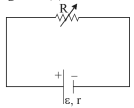
A variable resistor R, electromotive force and internal resistance $r$ are joined as shown in the given figure across the ends of the cell. Draw graph to show (i) terminal voltage and (ii) current $I$ as a function of $R$.
Image
"In microscope and telescope the value of resolving power should be enough alongwith high magnifying power." Comment on this statement.
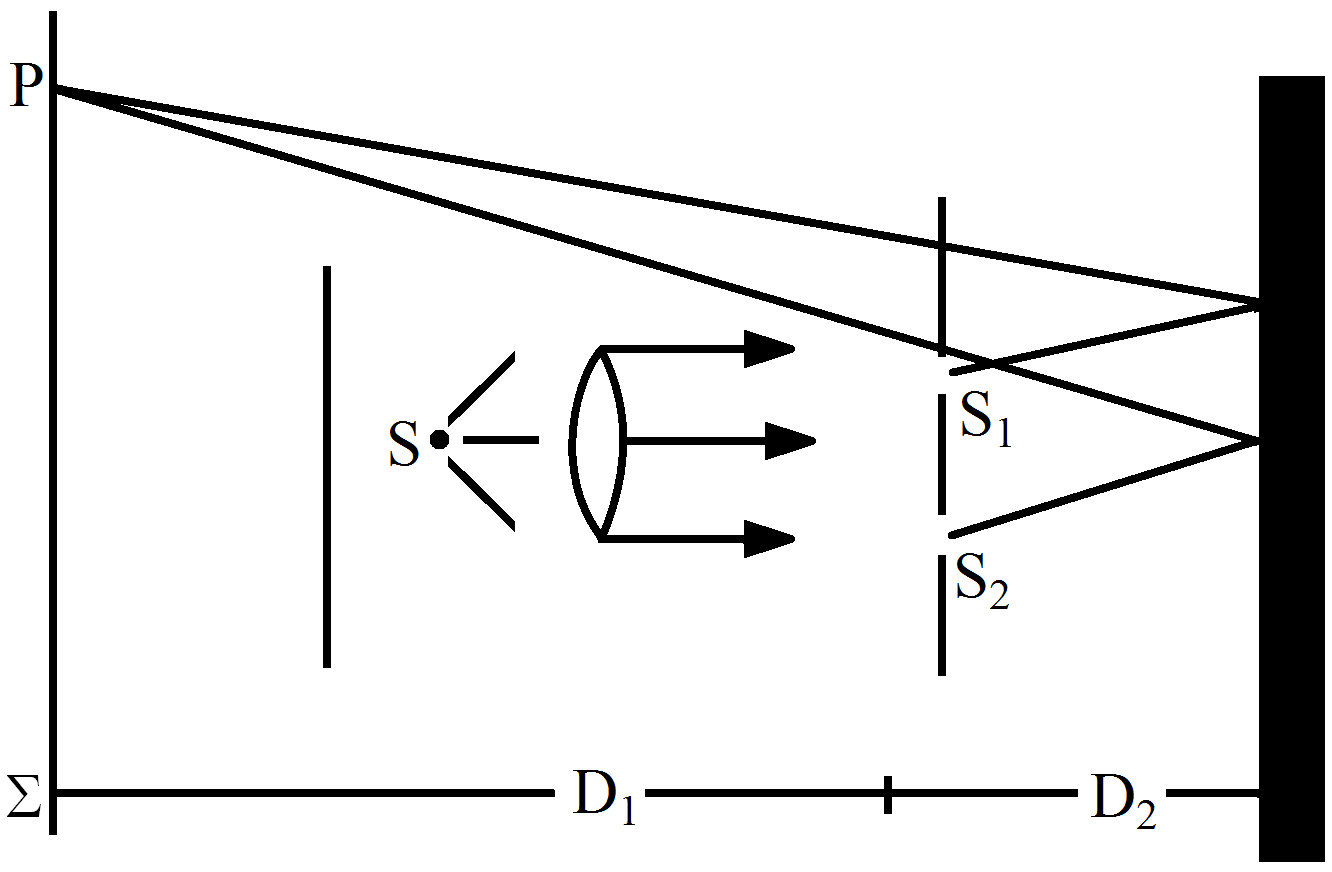
A double slit S1 - S2 is illuminated by a coherent light of wavelength $\lambda$. The slits are separated by a distance d. A plane mirror is placed in front of the double slit at a distance D1 from it and a screen $\sum$ is placed behind the double slit at a distance D2 from it (figure 17-E2). The screen E receives only the light reflected by the mirror. Find the fringe-width of the interference pattern on the screen.