Question
Briefly explain the jumping ring experiment.

Answer

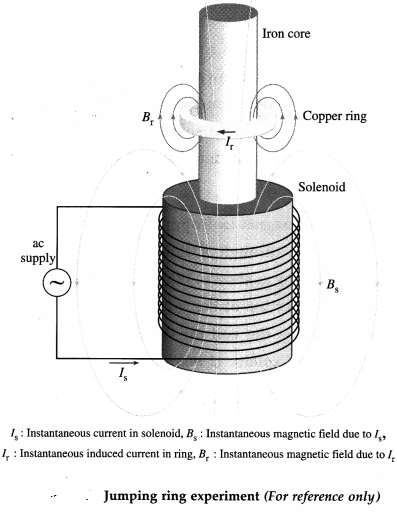
Elihu Thompson’s jumping ring experiment is an outstanding demonstration of Faraday’s laws and Lenz’s law of electromagnetic induction. The apparatus consists of a cylindrical laminated iron- cored solenoid. A conducting non-magnetic ring, usually copper or aluminium, is placed over the extended vertical core of the solenoid. When an alternating current is passed through the solenoid, the ring is thrown off high into the air.
Image
Due to ac, the magnetic field of the solenoid changes continuously. This induces eddy current in the ring. By Lenz’s law, the magnetic field produced by the induced eddy current in the ring opposes the changing magnetic field of the solenoid. Consequently, the two magnetic fields repel each other, making the ring jump.
The iron core increases the magnetic field of the solenoid. Often, the ring is cooled with liquid nitrogen. The colder the ring, the less is its resistance and greater the eddy current in it. More current means a greater magnetic field and even higher jumps.

Need a full question paper?

Generate a complete, print-ready paper with questions like this in minutes — across 16+ boards, with answer keys.

Start Generating Free

Similar questions

State the first law of thermodynamics. Express it in mathematical form.
Explain why the magnetic force on a charged particle cannot change the linear speed and the kinetic energy of the particle.###One implication of the Lorentz force law is that magnetic force does no work. Justify.
The flux rule is the terminology that Feynman used to refer to the law relating magnetic flux to emf. (RP Feynman, Feynman lectures on Physics, Vol II)
State the postulates of Bohr’s atomic model and derive the expression for the energy of an electron in the atom.
Draw a p-V diagram and explain the concept of positive and negative work. Give one example each.
State and explain Prevost's theory of exchange of heat.
Two wires of the same material and same cross-section are stretched on a sonometer. One wire is loaded with $1.5\ kg$ and another is loaded with $6\ kg.$ The vibrating length of first wire is $60\ cm$ and its fundamental frequency of vibration is the same as that of the second wire. Calculate vibrating length of the other wire.

Two vertical glass plates are held parallel $0.5 \mathrm{~mm}$ apart, dipped in water. If the surface tension of water is $70 \mathrm{dyn} / \mathrm{cm}$, calculate the height to which water rises between the two plates.
Define magnetization. State its SI unit and dimensions. Derive the relation between magnetic field intensity(H) and magnetization(M) for a magnetic material placed in a magnetic field.
A resistor held in running water carries electric current. Treat the resistor as the system
(a) Does heat flow into the resistor?
(b) Is there a flow of heat into the water?
(c) Is any work done?
(d) Assuming the state of resistance to remain unchanged, apply the first law of thermodynamics to this process.