MCQ
Bromination take place at
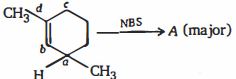
  • $a$
  • B
    $b$
  • C
    $c$
  • D
    $d$

Answer

Correct option: A.
$a$
a
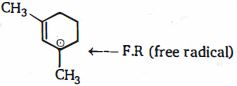
$(a)$ Reaction-proceed through stable free radical. 

$\therefore$ formation of stable $3^o$ free  radical at $(a)$

$\therefore$ Bromination of $(a)$ is most favourable.
Need a full question paper?

Generate a complete, print-ready paper with questions like this in minutes — across 16+ boards, with answer keys.

Start Generating Free

Similar questions

In the reaction ${B_2}{O_3} + C + C{l_2} \to A + CO.$ The $A$ is
If on adding $FeCl_3$ solution to acidified Lassaigne solution, of organic compound a blood redcolouration is producted, it indicates the presence of 
The first, second and third ionisation energies  $(E_1 ,E_2$ & $E_3 )$ for an element are  $7\,eV, 12.5\,eV$ and $42.5\,eV$ respectively. The most stable oxidation state of the  element will be
Which is not found in alkenes
Assign $A, B, C, D$ from given type of reaction. $C{u^{2 + }}\left( {aq.} \right) + 2{I^ - } \longrightarrow CuI \downarrow  + \frac{1}{2}{I_2}$
Ionisation constant of a weak acid $(HA)$ in terms of $\Lambda _m^\infty $ and ${\Lambda _m}$ is
Which of the following series correctly represents relations between the elements from $X$ to $Y$ ? $X \to Y$
Heating an aqueous solution of aluminium chloride to dryness will give:
The metals present in insulin and haemoglobin are respectively
The following data was obtained for chemical reaction given below at $975\, \mathrm{~K}$.

$2 \mathrm{NO}_{(\mathrm{g})}+2 \mathrm{H}_{2(\mathrm{~g})} \rightarrow \mathrm{N}_{2(\mathrm{~g})}+2 \mathrm{H}_{2} \mathrm{O}_{(\mathrm{g})}$


$[NO]$

$\mathrm{mol} \mathrm{L}^{-1}$

${H}_{2}$

$\mathrm{mol} \mathrm{L}^{-1}$

Rate 

$\mathrm{mol}L^{-1}$ $s^{-1}$

$(A)$ $8 \times 10^{-5}$ $8 \times 10^{-5}$ $7 \times 10^{-9}$
$(B)$ $24 \times 10^{-5}$ $8 \times 10^{-5}$ $2.1 \times 10^{-8}$
$(C)$ $24 \times 10^{-5}$ $32 \times 10^{-5}$ $8.4 \times 10^{-8}$

The order of the reaction with respect to $\mathrm{NO}$ is ..... .