MCQ
By a surface of a liquid we mean.
 
  • A
    A geometrical plane like $x=0$
  • B
    All molecules exposed to the atmosphere.
  • A layer of thickness of the order of $10^{-8} \mathrm{~m}$.
  • D
    A layer of thickness of the order of $10^{-4} \mathrm{~m}$.

Answer

Correct option: C.
A layer of thickness of the order of $10^{-8} \mathrm{~m}$.
The surface of a liquid refers to the layer of molecules that have higher potential energy than the bulk of the liquid. This layer is typically $10$ to $15$ times the diameter of the molecule.
Now, the size of an average molecule is around $1 \mathrm{~nm}=10^{-9} \mathrm{~m}$ so a diameter of $10$ to $15$ times would be of order, $10 \times 10^{-9}=10^{-8} \mathrm{~m}$.

Need a full question paper?

Generate a complete, print-ready paper with questions like this in minutes — across 16+ boards, with answer keys.
Start Generating Free

Similar questions

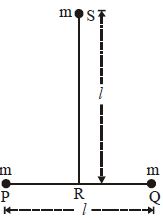
Two particles each of mass $m$ are placed at points $P$ and $Q$ as shown in the figure. $R$ is the mid-point of $PQ = l$. The gravitational force on the third particle of mass $m$ placed at point $S$ on the perpendicular bisector of $PQ$ is
When frequency of oscillations is high then motion is called:
On the basis of kinetic theory of gases, the gas exerts pressure because its molecules:
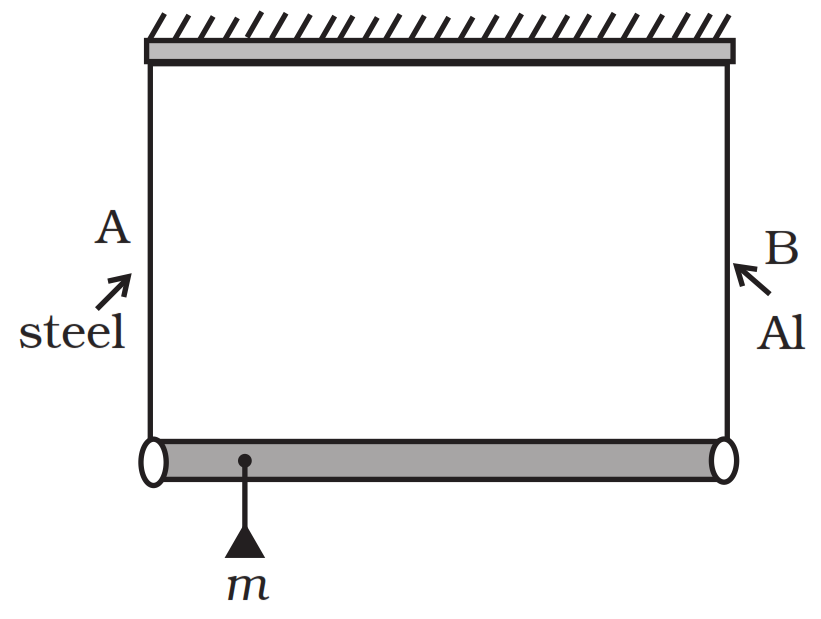
A rod of length $I$ and negligible mass is suspended at its two ends by two wires of steel $($wire $A )$ and aluminium $($wire $B)$ of equal lengths. The cross $-$ sectional areas of wires $A$ and $B$ are $1.0 mm^2$ and $2.0 mm^2$, respectively. $\left(Y_{\text {al }}=70 \times 10 Nm ^{-2}\right.$ and $\left.Y_{\text {steel }}=200 \times 10^9 Nm ^{-2}\right)$
The ratio of maximum acceleration to maximum velocity in a simple harmonic motion is $10\,s^{-1}$.  At, $t = 0$ the displacement is $5\, m$. What is the maximum acceleration ? The initial phase is $\frac{\pi }{4}$
That gas cannot be liquified
A uniform sphere is placed on a smooth horizontal surface and a horizontal force $F$ is applied on it at a distance h above the surface. The acceleration of the centre:
The ratio of the weight of a man in a stationary lift and when it is moving downward with uniform acceleration $‘a’$ is $3 : 2$. The value of $‘a’$ is ($g-$Acceleration due to gravity of the earth)
A charged particle goes undeflected in a region containing an electric and a magnetic field. It is possible that
  1. $\overrightarrow{\text{E}}||\overrightarrow{\text{B}},\ \overrightarrow{\text{v}}||\overrightarrow{\text{E}}$
  2. $\overrightarrow{\text{E}}$ is not parallel to $\overrightarrow{\text{B}}$
  3. $\overrightarrow{\text{v}}||\overrightarrow{\text{B}}$ but $\overrightarrow{\text{E}}$ is not parallel to $\overrightarrow{\text{B}}$
  4. $\overrightarrow{\text{E}}||\overrightarrow{\text{B}}$ but $\overrightarrow{\text{v}}$ is not parallel to $\overrightarrow{\text{E}}$
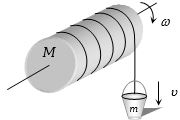
A cylinder of mass $M$ and radius $r$ is mounted on a frictionless axle over a well. A rope of negligible mass is wrapped around the cylinder and a bucket of mass $m$ is suspended from the rope. The linear acceleration of the bucket will be