Question
By defining conduction current, explain why Maxwell propounded the idea of displacement current?

Answer

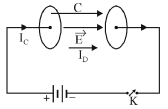
Conduction current : Current flowing by the wires joining the circuit, in the circuit is known as conduction current. Let a capacitor is charged by a current I by a battery. It is clear from the figure that during charging conduction current is flowing from left to right outside the plates of the capacitor and there is no conduction current I between the plates of the capacitor.
Image
To remove this contradiction, Maxwell introduced a new concept of displacement current $\left(I_D\right)$ and its source to be the changing electric field between the plates of the capacitor. It has been introduced to show that current flowing outside the capacitor (conduction current, $I _{ C }$ ) is equal to the current flowing in the capacitor (displacement current, $I_D$ ). According to condition put by Maxwell, conduction current ( $I_C$ ) flows in the left plate of the capacitor and displacement current $\left(I_D\right)$ flows towards the right plate in the capacitor.

Need a full question paper?

Generate a complete, print-ready paper with questions like this in minutes — across 16+ boards, with answer keys.
Start Generating Free

Similar questions

A spy report about a suspected car reads as follows. "The car moved 2.00km towards east, made a perpendicular left turn, ran for 500m, made a perpendicular right turn, ran for 4.00km and stopped". Find the displacement of the car.
Write and explain the super position principle (of waves).
  1. Write the expression for the force $ \overrightarrow{\text{F}}$ acting on a particle of mass m and charge q moving with velocity $ \overrightarrow{\text{V}} $ in a magnetic field $ \overrightarrow{\text{B}}$ Under what conditions will it move in (i) a circular path and (ii) a helical path?
  2. Show that the kinetic energy of the particle moving in a magnetic field remains constant.
Is it easier to take out a nucleon from carbon or from iron? Fi-om iron or from lead?
$A$ cell of emf $E$ and internal resistance $r$ is connected across a variable load resistor $R$. Draw the plots of the terminal voltage $V$ versus $(i)$ resistance $R$ and $(ii)$ current $I$.
It is found that when $R=4 \Omega$, the current is $1 A$ and when $R$ is increased to $9 \Omega$, the current reduces to $0.5 A$ .Find the values of the emf $E$ and internal resistance $r$.
Answer the following questions:
  1. In a double slit experiment using light of wavelength $600 \ nm$, the angular width of the fringe formed on a distant screen is $0.1^o$. Find the spacing between the two slits.
  2. Light of wavelength $5000 \mathring A$ . Propagating in air gets partly reflected from the surface of water. How will the wavelengths and frequencies of the reflected and refracted light be affected?
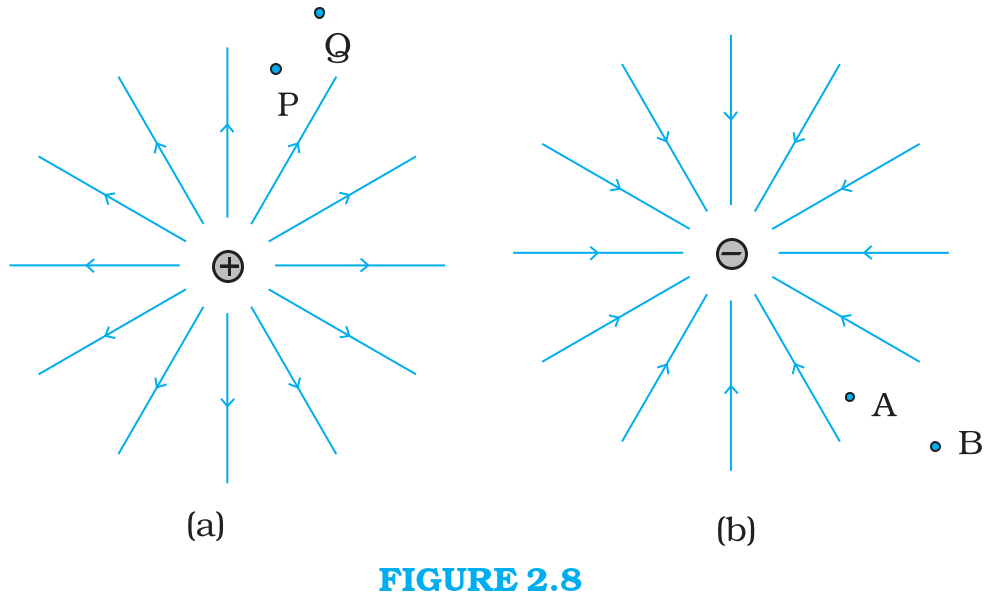
Figures 2.8 (a) and (b) show the field lines of a positive and negative point charge respectively.
Image
(a) Give the signs of the potential difference $V_{ P }-V_{ Q } ; V_{ B }-V_{ A }$.
(b) Give the sign of the potential energy difference of a small negative charge between the points $O$ and $P ; A$ and $B$.
(c) Give the sign of the work done by the field in moving a small positive charge from $Q$ to $P$.
(d) Give the sign of the work done by the external agency in moving a small negative charge from $B$ to $A$.
(e) Does the kinetic energy of a small negative charge increase or decrease in going from $B$ to $A$ ?
An electron and alpha particle have the same kinetic energy. How are the de Broglie wavelengths associated with them related?
The work function of a metal is $2.5 \times 10^{-19}J.$
  1. Find the threshold frequency for photoelectric emission.
  2. If the metal is exposed to a light beam of frequency $6.0 \times 10^{-14} Hz,$ what will be the stopping potential?
Can we have magnetic hysteresis in paramagnetic or diamagnetic substances?