Question
By explaining diamagnetic, paramagnetic and ferromagnetic substances, analyse their characteristic properties.###Define diamagnetic, paramagnetic and ferromagnetic substances and analyse their characteristics on the basis of (a) reason for magnetic property (b) relative magnetic permeability (c) magnetic susceptibility (d) intensity of magnetisation (e) magnetic induction.
Answer

SELF

Need a full question paper?

Generate a complete, print-ready paper with questions like this in minutes — across 16+ boards, with answer keys.

Start Generating Free

Similar questions

Sunil and his parents were travelling to their village in their car. On the way his mother noticed some grey coloured panels installed on the roof of a low building. She enquired from Sunil what those panels were and Sunil told his mother that those were solar panels.
  1. What were the values displayed by Sunil and his mother? State one value for each.
  2. In what way would the use of solar panels prove to be very useful?
  3. Name the semiconductor device used in solar panels. Briefly explain with the help of a diagram, how this device works.
Define resolving power of a compound microscope. How does the resolving power of a compound microscope change when:
  1. Refractive index of medium between the object and objective lens increases.
  2. Wavelength of radiation used is increased?
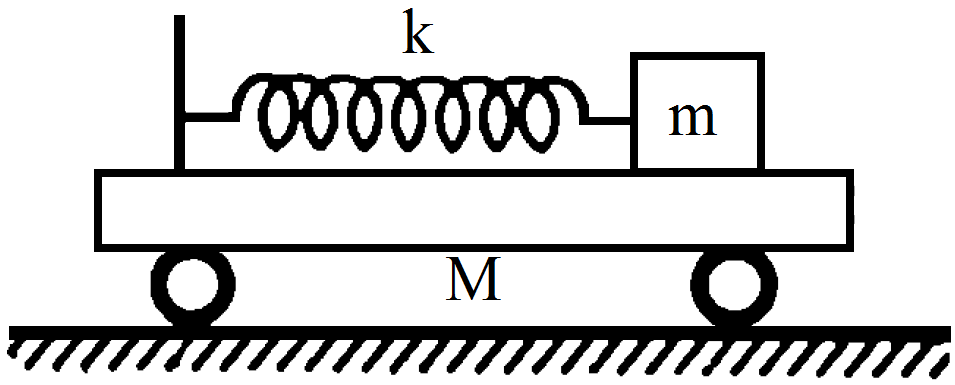
All the surfaces shown in are frictionless. The mass of the car is M, that of the block is m and the spring has spring constant k. Initially, the car and the block are at rest and the spring is stretched through a length x, when the system is released.
  1. Find the amplitudes of the simple harmonic motion of the block and of the car as seen from the road.
  2. Find the time period(s) of the two simple harmonic motions.
A particle of mass m and charge q is thrown at a speed u against a uniform electric field E. How much distance will it travel before coming to momentary rest?
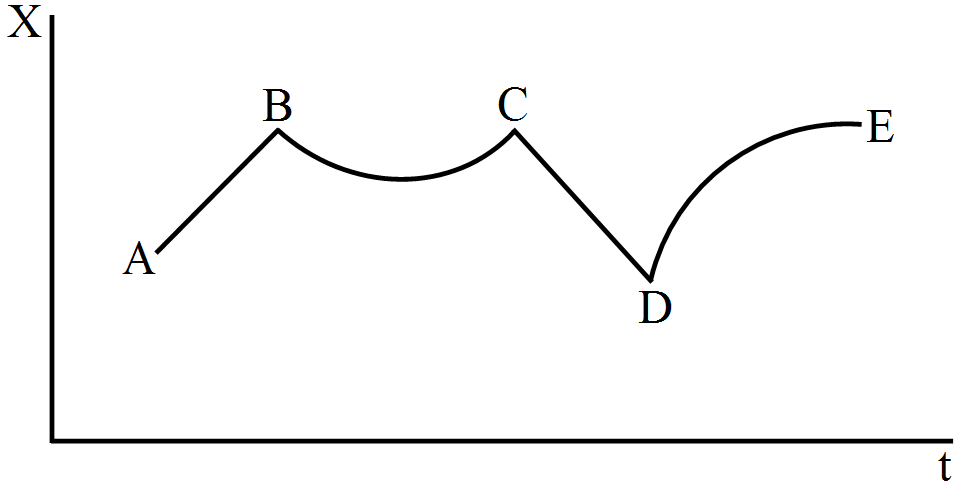
Figure shows the displacement of a particle going along the X-axis as a function of time. The force acting on the particle is zero in the region:
  1. AB
  2. BC
  3. CD
  4. DE
Suppose we want to verify the analogy between electrostatic and magnetostatic by an explicit experiment. Consider the motion of (i) electric dipole p in an electrostatic field E and (ii) magnetic dipole m in a magnetic field B. Write down a set of conditions on E, B, p, m so that the two motions are verified to be identical. (Assume identical initial conditions.)
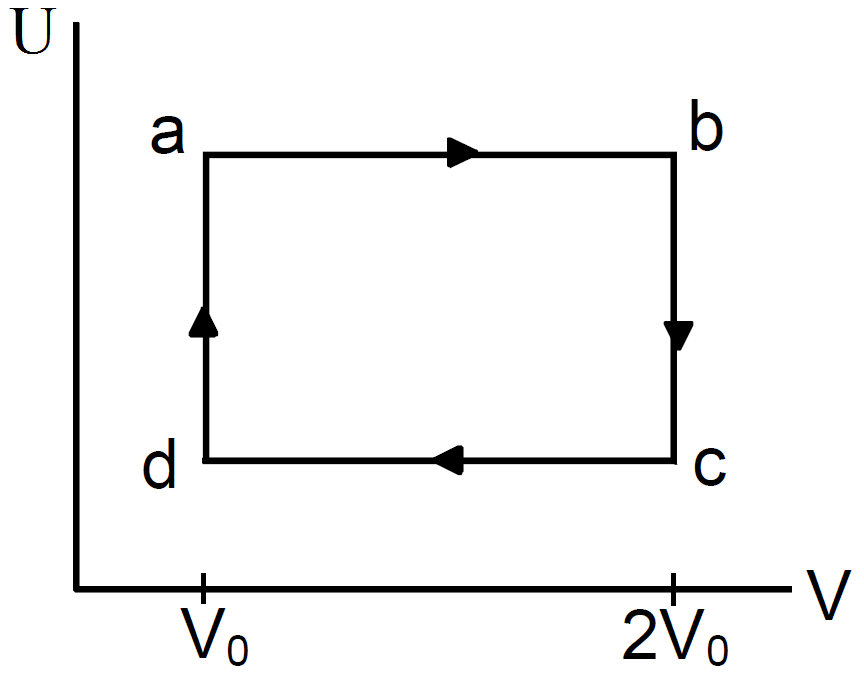
Figure. shows the variation in the internal energy U with the volume V of 2.0mol of an ideal gas in a cyclic process abcda. The temperatures of the gas at b and c are 500K and 300K respectively. Calculate the heat absorbed by the gas during the process.
A source emitting sound at frequency 4000Hz, is moving along the Y-axis with a speed of 22m/s. A listener is situated on the ground at the position (660m, 0). Find the frequency of the sound received by the listener at the instant the source the origin. Speed of sound in air = 330m/s.
An ideal gas is trapped between a mercury column and the closed-end of a narrow vertical tube of uniform base containing the column. The upper end of the tube is open to the atmosphere. The atmospheric pressure equals 76cm of mercury. The lengths of the mercury column and the trapped air column are 20cm and 43cm respectively. What will be the length of the air column when the tube is tilted slowly in a vertical plane through an angle of 60°? Assume the temperature to remain constant.
With the help of a neat and labelled diagram, explain the underlying principle and working of a moving coil galvanometer. What is the function of:
  1. Uniform radial field.
  2. Soft iron core in.
In such a device?