Question
By explaining diamagnetic, paramagnetic and ferromagnetic substances, analyse their characteristic properties.###Define diamagnetic, paramagnetic and ferromagnetic substances and analyse their characteristics on the basis of (a) reason for magnetic property (b) relative magnetic permeability (c) magnetic susceptibility (d) intensity of magnetisation (e) magnetic induction.
Answer

SELF

Need a full question paper?

Generate a complete, print-ready paper with questions like this in minutes — across 16+ boards, with answer keys.

Start Generating Free

Similar questions

Consider a metal exposed to light of wavelength 600nm. The maximum energy of the electron doubles when light of wavelength 400snm is used. Find the work function in eV.
A neutron moving with a speed υ strikes a hydrogen atom in ground state moving towards it with the same speed. Find the minimum speed of the neutron for which inelastic (completely or partially) collision may take place. The mass of neutron = mass of hydrogen = 1.67 × 10⁻²⁷kg.
Solve the previous problem if the pulley has a moment of inertia I about its axis and the string does not slip over it.
A bar magnet of length 1cm and cross-sectional area 1.0cm2 produces a magnetic field of 1.5 × 10. T at a point in end-on position at a distance 15cm away from the centre.
  1. Find the magnetic moment M of the magnet.
  2. Find the magnetization I of the magnet.
  3. Find the magnetic field B at the centre of the magnet.
A small piece of cesium metal ($\phi$ = 1 ·9 eV) is kept at a distance of 20cm from a large metal plate having a charge density of 1.0 × 10⁻⁹C/m2 on the surface facing the cesium piece. A monochromatic light of wavelength 400nm is incident on the cesium piece. Find the minimum and the maximum kinetic energy of the photoelectrons reaching the large metal plate. Neglect any change in electric field due to the small piece of cesium present.
 An inductor-coil of inductance 20mH having resistance $10\Omega$ is joined to an ideal battery of emf 5.0V. Find the rate of chenge of the induced emf at:
  1. t = 0
  2. t = 10ms
  3. t = 1.0s. 
A composite slab is prepared by pasting two plates of thicknesses L1 and L2 and thermal conductivities K1 and K2. The slabs have equal cross-sectional area. Find the equivalent conductivity of the composite slab.
A bar magnet of length 1cm and cross-sectional area 1.0cm2 produces a magnetic field of 1.5 × 10. T at a point in end-on position at a distance 15cm away from the centre.
  1. Find the magnetic moment M of the magnet.
  2. Find the magnetization I of the magnet.
  3. Find the magnetic field B at the centre of the magnet.
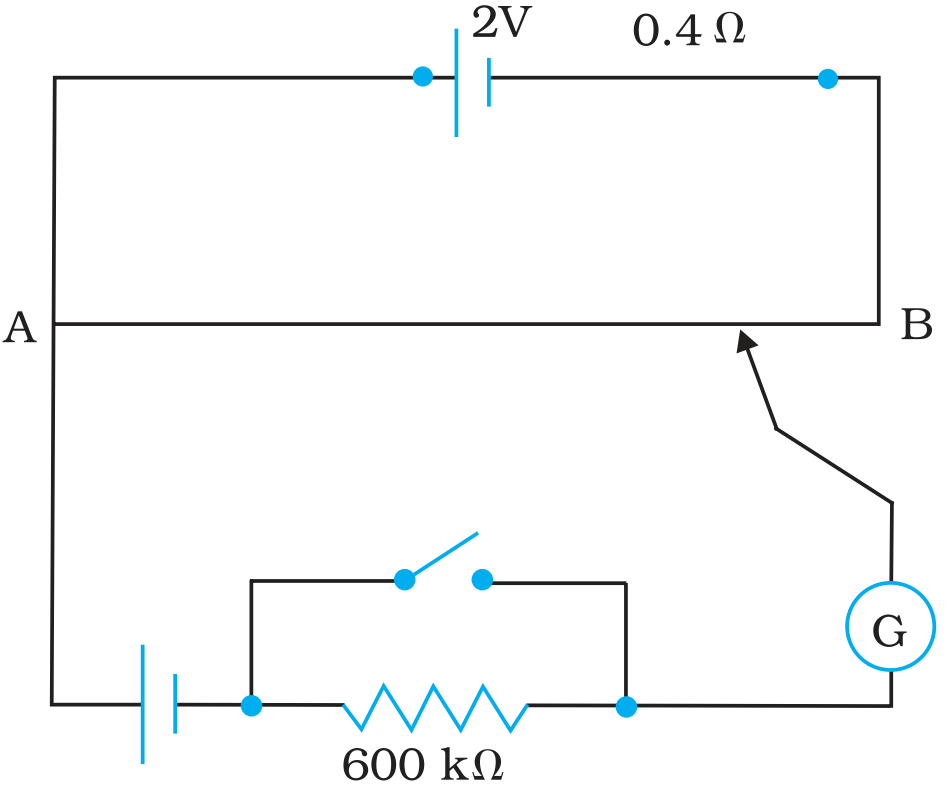
Figure shows a potentiometer with a cell of 2.0 V and internal resistance $0.04\ \Omega$ maintaining a potential drop across the resistor wire AB. A standard cell which maintains a constant emf of 1.02 V (for very moderate currents upto a few mA) gives a balance point at 67.3 cm length of the wire. To ensure very low currents drawn from the standard cell, a very high resistance of $600\ \text{k}\Omega$ is put in series with it, which is shorted close to the balance point. The standard cell is then replaced by a cell of unknown emf $\varepsilon$ and the balance point found similarly, turns out to be at 82.3 cm length of the wire.

  1. What is the value $\varepsilon?$
  2. What purpose does the high resistance of $600\ \text{k}\Omega$ have?
  3. Is the balance point affected by this high resistance?
  4. Is the balance point affected by the internal resistance of the driver cell?
  5. Would the method work in the above situation if the driver cell of the potentiometer had an emf of 1.0 V instead of 2.0 V?
  6. Would the circuit work well for determining an extremely small emf, say of the order of a few mV (such as the typical emf of a thermo-couple)? If not, how will you modify the circuit?
A particle of charge 2.0 × 10⁻⁸C and mass 2.0 × 10⁻¹⁰g is projected with a speed of 2.0 × 10³m/s-1in a region with a uniform magnetic field of 0.10T. The velocity is perpendicular to the field. Find the radius of the circle formed by the particle and also the time period.