Question
By explaining diamagnetic, paramagnetic and ferromagnetic substances, analyse their characteristic properties.###Define diamagnetic, paramagnetic and ferromagnetic substances and analyse their characteristics on the basis of (a) reason for magnetic property (b) relative magnetic permeability (c) magnetic susceptibility (d) intensity of magnetisation (e) magnetic induction.
Answer

SELF

Need a full question paper?

Generate a complete, print-ready paper with questions like this in minutes — across 16+ boards, with answer keys.

Start Generating Free

Similar questions

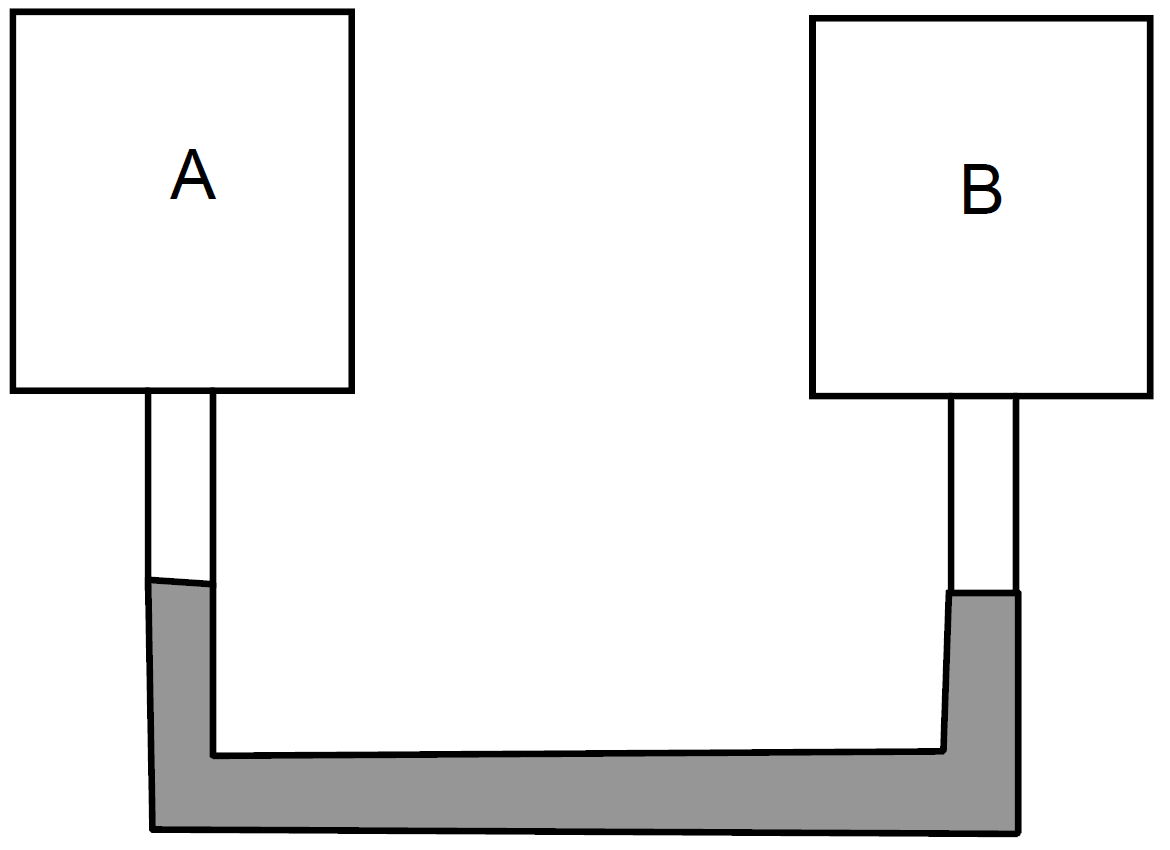
Figure shows two rigid vessels A and B, each of volume 200cm3, containing an ideal gas (Cv = 12.5JK-1mol-1). The vessels are connected to a manometer tube containing mercury. The pressure in both the vessels is 75cm of mercury and the temperature is 300K.
  1. Find the number of moles of the gas in each vessel.
  2. 5.0J of heat is supplied to the gas in vessel A and 10J to the gas in vessel B. Assuming there's no appreciable transfer of heat from A to B, calculate the difference in the heights of mercury in the two sides of the manometer. Gas constant, R = 8.3JK-1mol-1.

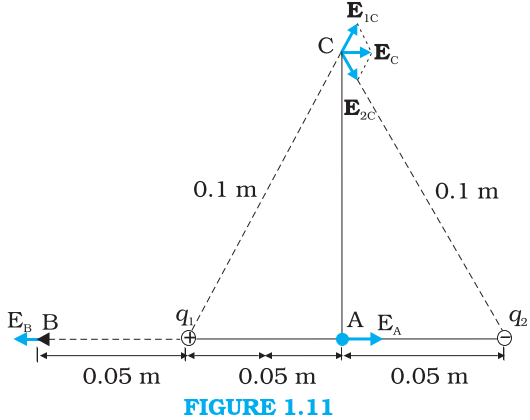
Two point charges $q_1$ and $q_2$, of magnitude $+10^{-8} C$ and $-10^{-8} C$, respectively, are placed $0.1 m$ apart. Calculate the electric fields at points A, B and C shown in Fig. 1.11.
Image
The temperature and humidity of air are 27°C and 50% on a particular day. Calculate the amount of vapour that should be added to 1 cubic metre of air to saturate it. The saturation vapour pressure at 27°C = 3600Pa.
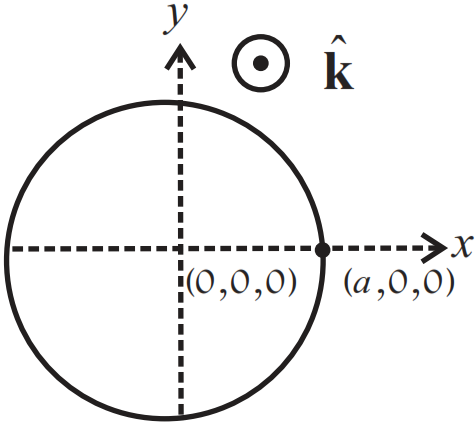
A magnetic field in a certain region is given by $\text{B}=\text{B}_0\cos(\omega\text{t})\hat{\text{k}}$ and a coil of radius a with resistance R is placed in the x-y plane with its centre at the origin in the magnetic field (see Fig). Find the magnitude and the direction of the current at (a, 0, 0) at $\text{t}=\frac{\pi}{2\omega},\text{t}=\frac{\pi}{\omega} \text{ and }\text{t}=\frac{3\pi}{2\omega}$.

Two coherent point sources S1 and S2 vibrating in phase emit light of wavelength $\lambda$. The separation between the sources is $2\lambda$. Consider a line passing through S2 and perpendicular to the line S1S2. What is the smallest distance from S2 where a minimum of intensity occurs?
Water leaks out from an open tank through a hole of area 2mm2 in the bottom. Suppose water is filled up to a height of 80cm and the area of cross-section of the tank is 0.4m2. The pressure at the open surface and at the hole are equal to the atmospheric pressure. Neglect the small velocity of the water near the open surface in the tank.
  1. Find the initial speed of water coming out of the hole.
  2. Find the speed of water coming out when half of water has leaked out.
  3. Find the volume of water leaked out during a time interval dt after the height remained is h. Thus find the decrease in height dh in terms of h and dt.
  4. From the result of part c find the time required for half of the water to leak out.
With the help of a circuit, show how a moving coil galvanometer can be converted into an ammeter of a given range. Write the necessary mathematical formula.
A particle is fired vertically upward from earth's surface and it goes up to a maximum height of 6400km. Find the initial speed of the particle.
A source contains two phosphorous radio nuclides $^{32}_{15}\text{P }(\text{T}_{1/2}=14.3\text{d})$ and $^{33}_{15}\text{P }(\text{T}_{1/2}=25.3\text{d})$ Initially, 10% of the decays come from $^{33}_{15}\text{P}.$ How long one must wait until 90% do so?
 An inductor-coil of inductance 20mH having resistance $10\Omega$ is joined to an ideal battery of emf 5.0V. Find the rate of chenge of the induced emf at:
  1. t = 0
  2. t = 10ms
  3. t = 1.0s.