Question
By explaining magnetic field lines, write their characteristics.

Answer

SELF

Need a full question paper?

Generate a complete, print-ready paper with questions like this in minutes — across 16+ boards, with answer keys.
Start Generating Free

Similar questions

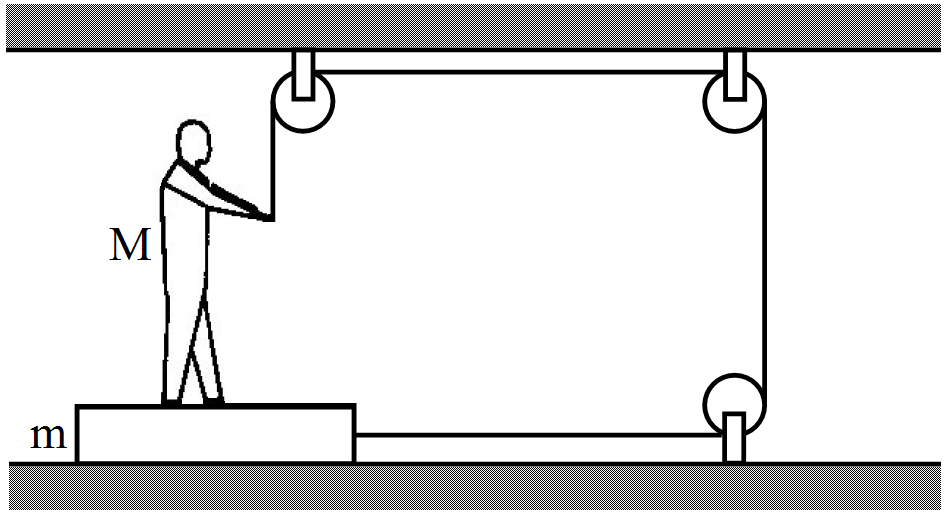
The friction coefficient between the board and the floor shown in figure is $\mu.$ Find the maximum force that the man can exert on the rope so that the board does not slip on the floor.
A bar magnet of magnetic moment m and moment of inertia I (about centre, perpendicular to length) is cut into two equal pieces, perpendicular to length. Let T be the period of oscillations of the original magnet about an axis through the mid point, perpendicular to length, in a magnetic field B. What would be the similar period T' for each piece?
A free $^{238}U$ nucleus kept in a train emits an alpha particle. When the train is stationary, $a$ nucleus decays and $a$ passenger measures that the separation between the alpha particle and the recoiling nucleus becomes $x$ at time $t$ after the decay. If the decay takes place while the train is moving at a uniform velocity $v,$ the distance between the alpha particle and the recoiling nucleus at $a$ time $t$ after the decay as measured by the passenger is:
A coil of number of turns N, area A is rotated at a constant angular speed ω, in a uniform magnetic field B and connected to a resistor R. Deduce expression for:
  1. Maximum emf induced in the coil.
  2. Power dissipation in the coil.
A lady uses +1.5D glasses to have normal vision from 25cm onwards. She uses a 20D lens as a simple microscope to see an object. Find the maximum magnifying power if she uses then microscope
  1. Together with her glass
  2. Without the glass. Do the answers suggest that an object can be more clearly seen through a microscope without using the correcting glasses?
A biconvex thick lens is constructed with glass $(\mu=1.50)$ Each of the surfaces has a radius of $10\ cm$ and the thickness at the middle is $5\ cm.$ Locate the image of an object placed far away from the lens.
A hemispherical portion of the surface of a solid glass sphere $(\mu=1.5)$ of radius r is silvered to make the inner side reflecting. An object is placed on the axis of the hemisphere at a distance 3r from the centre of the sphere. The light from the object is refracted at the unsilvered part, then reflected from the silvered part and again refracted at the unsilvered part. Locate the final image formed.
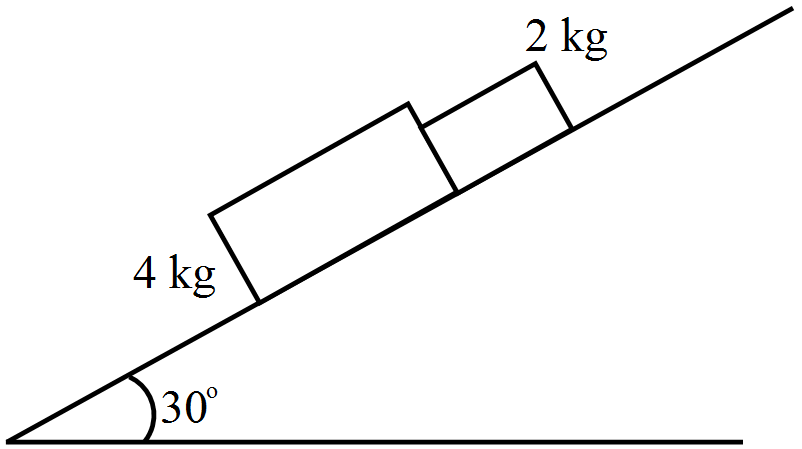
Figure shows two blocks in contact sliding down an inclined surface of inclination $30^\circ .$ The friction coefficient between the block of mass $2.0\ kg$ and the incline is $\mu_1,$ and that between the block of mass $4.0\ kg$ and the incline is $\mu_2.$ Calculate the acceleration of the $2.0\ kg$ block if:
  1. $\mu_1=0.20$ and $\mu_2=0.30$
  2. $\mu_1=0.30$ and $\mu_2=0.20$ Take $\text{g}=10\text{m/s}^2.$
The electric field associated with a light wave is given by $\text{E}=\text{E}_0\sin[(1.57\times10^7\text{m}^{-1})(\text{x}-{\text{ct}})].$ Find the stopping potential when this light is used in an experiment on photoelectric effect with the emitter having work function $1.9\ \ce{ev}.$
A particle is subjected to two simple harmonic motions given by $\text{x}_1=2.0\sin(100\pi\text{t})$ and $\text{x}_2=2.0\sin\Big(120\pi\text{t}+\frac{\pi}{3}\Big)$ where x is in centimeter and t in second. Find the displacement of the particle at
  1. t = 0.0125.
  2. t = 0.025.