Question
By graphical method, the solution of linear programming problem
Maximize $Z = 3x_1 + 5x_2$
Subject to
$3x_1 + 2x_2 \leq 18$
$x_1 \leq 4$
$x_2 \leq 6$
$x_1 \geq 0, x_2 \geq 0,$ is:
Answer

We need to maximize the function $Z = 3x_4 + 5x_2$
First, we will convert the given inequations into equations, we obtain the following equations:
$3x_1 + 2x_2 = 18, x_1 = 4, x_2 = 6, x_1 = 0$ and $x_2 = 0$
Region represented by $3x_1 + 2x_2 \leq 18:$
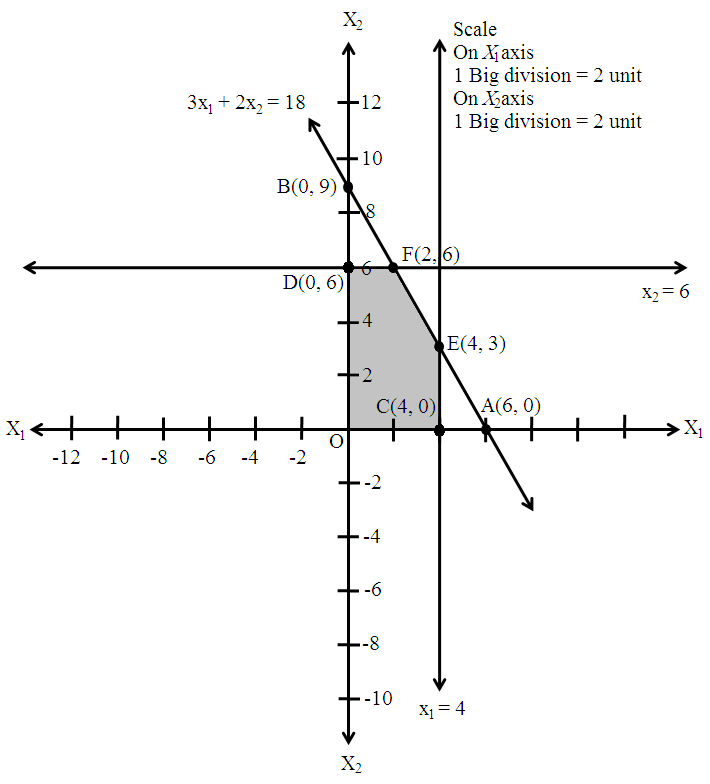
The line $3x_1 + 2x_2 = 18$ meets the coordinate axes at $A(6, 0)$ and $B(0, 9)$ respectively.
By joining these points we obtain the line $3x_1 + 2x_2 = 18.$
Clearly $(0, 0)$ satisfies the inequation $3x_1 + 2x_2 = 18.$
So the region in the plane which contain the origin represents the solution set of the inequation $3x_1 + 2x_2 \leq 18.$
Region represented by $x_1 \leq 4:$
The line $x_1 = 4$ is the line that passes through $C(4, 0)$ and is parallel to the $Y$ axis.
The region to the left of the line $x_1 = 4$ will satisfy the inequation $x_1 \leq 4.$
Region represented by $x_2 \leq 6:$
The line $x_2 = 6$ is the line that passes through $D(0, 6)$ and is parallel to the $X$ axis.
The region below the line $x_2 = 6$ will satisfy the inequation $X_2 \leq 6.$
Region represented by $x_1 \geq 0$ and $x_2 \geq 0:$
Since, every point in the first quadrant satisfies these inequations.
So, the first quadrant is the region represented by the inequations $x_1 \geq 0$ and $x_2 \geq 0.$
The feasible region determined by the system of constraints, $3x_1 + 2x_2 \leq 18, x_1 \leq 4, x_2 \leq 6, x_1 \geq 0$ and $x_2 \geq 0$ are as follows

Corner points are $O(0, 0), D(0, 6), F(2, 6), E(4, 3)$ and $C(4, 0).$
The values of the objective function at these points are given in the following table.
Points
Value of Z
$O(0, 0)$ $3(0) + 5(0) = 0$
$D(0, 6)$ $3(0) + 5(6) = 30$
$F(2, 6)$ $3(2) + 5(6) = 36$
$E(4, 3)$ $3(4) + 5(3) = 27$
$C(4, 0)$ $3(4) + 5(0) = 12$
We see that the maximum value of the objective function $Z$ is $36$ which is at $F(2, 6).$

Need a full question paper?

Generate a complete, print-ready paper with questions like this in minutes — across 16+ boards, with answer keys.

Start Generating Free

Similar questions

Choose the correct answer from the given four option.
Which of the following is a second order differential equation?
  1. $(\text{y}')^2+\text{x}=\text{y}^2$
  2. $\text{y}'\text{y}''+\text{y}=\sin\text{x}$
  3. $\text{y}'''+(\text{y}'')^2+\text{y}=0$
  4. $\text{y}'=\text{y}^2$
If a matrix $A$ is both symmetric and skewsymmetric, then
If $\text{f(x)}=\sqrt{1-\sqrt{1-\text{x}^2}},$ then f(x) is:
  1. Continuous on [-1, 1] and differentiable on (-1, 1)
  2. Continuous on [-1, 1] and differentiable on $(-1,0)\cup(0,1)$
  3. Continuous and differentiable on [-1, 1]
  4. None of these.
The equation of the line passing through the points $\text{a}_1\hat{\text{i}}+\text{a}_2\hat{\text{j}}+\text{a}_3\hat{\text{k}}$ and $\text{b}\hat{\text{i}}+\text{b}_2\hat{\text{j}}+\text{b}_3\hat{\text{k}}$ is:
Choose the correct answer from the given four options.
Let A and B be two events such that $\text{P}(\text{A})=\frac{3}{8},\text{P}({\text{B}})=\frac{5}{8}$ and $\text{P}(\text{A}\cup\text{B})=\frac{3}{4}.$Then $\text{P}\Big(\frac{\text{A}}{\text{B}}\Big)\cdot\text{P}\Big(\frac{\text{A'}}{\text{B}}\Big)$ is equal to:
The probablity of selecting a male or a female is same. If the probability that in an office of n persons (n - 1) males being selected is $\frac{3}{2^{10}},$ the value of n is:
The value of $\tan^{-1}\Big(\frac{1}{2}\Big)+\tan^{-1}\Big(\frac{1}{3}\Big)+\tan^{-1}\Big(\frac{7}{8}\Big)$ is:
  1. $\tan^{-1}\Big(\frac{7}{8}\Big)$
  2. $\cot^{-1}(15)$
  3. $\tan^{-1}(15)$
  4. $\tan^{-1}\Big(\frac{25}{24}\Big)$
The distance of the line $\vec{\text{r}}=2\hat{\text{i}}-2\hat{\text{j}}+3\hat{\text{k}}+\lambda(\hat{\text{i}}-\hat{\text{j}}+4\hat{\text{k}})$ from the plane $\vec{\text{r}}.(\hat{\text{i}}+5\hat{\text{j}}+\hat{\text{k}})=5$ is:
  1. $\frac{5}{3\sqrt{3}}$
  2. $\frac{10}{3\sqrt{3}}$
  3. $\frac{25}{3\sqrt{3}}$
  4. $\text{None of these}$
If $A=\left[\begin{array}{r}1 \\ -4 \\ 3\end{array}\right]$ and $B=\left[\begin{array}{lll}-1 & 2 & 1\end{array}\right]$, then $(A B)^{\prime}$ is equal to
A fair die is tossed eight times. The probability that a third six is observed in the eight throw is: