MCQ
By graphical method, the solution of linear programming problem
Maximize $Z = 3x_1 + 5x_2$
Subject to
$3x_1 + 2x_2 \leq 18$
$x_1 \leq 4$
$x_2 \leq 6$
$x1 \geq 0, x2 \geq 0,$ is:
  • A
    $x_1 = 2, x_2 = 0, Z = 6$
  • B
    $x_1 = 2, x_2 = 6, Z = 36$
  • C
    $x_1 = 4, x_2 = 3, Z = 27$
  • D
    $x_1 = 4, x_2 = 6, Z = 42$

Answer

We need to maximize the function $Z = 3x_4 + 5x_2$ First, we will convert the given inequations into equations, we obtain the following equations:
$3x_1 + 2x_2 = 18, x_1 = 4, x_2 = 6, x_1 = 0$ and $x_2 = 0$
Region represented by $3x_1 + 2x_2 \leq 18:$
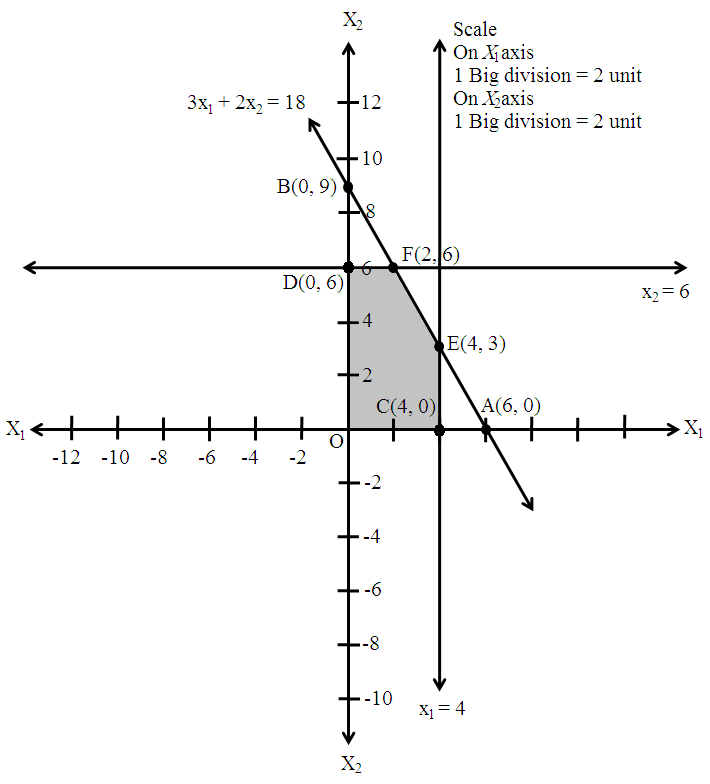
The line $3x_1 + 2x_2 = 18$ meets the coordinate axes at $A(6, 0)$ and $B(0, 9)$ respectively.
By joining these points we obtain the line $3X1 + 2x2 = 18.$
Clearly $(0, 0)$ satisfies the inequation $3x_1 + 2x_2 = 18.$
So the region in the plane which contain the origin represents the solution set of the inequation $3x_1 + 2x_2 \leq 18.$
Region represented by $x_1 \leq 4:$
The line $x_1 = 4$ is the line that passes through $C(4, 0)$ and is parallel to the $Y$ axis.
The region to the left of the line $x_1 = 4$ will satisfy the inequation $x_1 \leq 4.$
Region represented by $x_2 \leq 6:$
The line $x_2 = 6$ is the line that passes through $D(0, 6)$ and is parallel to the $X$ axis.
The region below the line $x_2 = 6$ will satisfy the inequation $X_2 \leq 6.$
Region represented by $x_1 \geq 0$ and $x_2 \geq 0:$
Since, every point in the first quadrant satisfies these inequations.
So, the first quadrant is the region represented by the inequations $x_1 \geq 0$ and $x_2 \geq 0.$
The feasible region determined by the system of constraints, $3x_1 + 2x_2 \leq 18, x_1 \leq 4, x_2 \leq 6, x_1 \geq 0$ and $x_2 \geq 0$ are as follows

Corner points are $O(0, 0), D(0, 6), F(2, 6), E(4, 3)$ and $C(4, 0).$
The values of the objective function at these points are given in the following table.
Points
Value of $Z$
$O(0, 0)$ $3(0) + 5(0) = 0$
$D(0, 6)$ $3(0) + 5(6) = 30$
$F(2, 6)$ $3(2) + 5(6) = 36$
$E(4, 3)$ $3(4) + 5(3) = 27$
$C(4, 0)$ $3(4) + 5(0) = 12$
We see that the maximum value of the objective function $Z$ is 36 which is at $F(2, 6).$

Need a full question paper?

Generate a complete, print-ready paper with questions like this in minutes — across 16+ boards, with answer keys.

Start Generating Free