MCQ
By graphical method, the solution of linear programming problem
Maximize $Z = 3x_1 + 5x_2$
Subject to
$3x_1 + 2x_2 \leq 18$
$x_1 \leq 4$
$x_2 \leq 6$
$x1 \geq 0, x2 \geq 0$, is:
  • A
    $x_1 = 2, x_2 = 0, Z = 6$
  • $x_1 = 2, x_2 = 6, Z = 36$
  • C
    $x_1 = 4, x_2 = 3, Z = 27$
  • D
    $x_1 = 4, x_2 = 6, Z = 42$

Answer

Correct option: B.
$x_1 = 2, x_2 = 6, Z = 36$
We need to maximize the function $Z = 3x_4 + 5x_2$
First, we will convert the given inequations into equations, we obtain the following equations:
$3x_1 + 2x_2 = 18, x_1 = 4, x_2 = 6, x_1 = 0$ and $x_2 = 0$
Region represented by $3x_1 + 2x_2 \leq 18:$
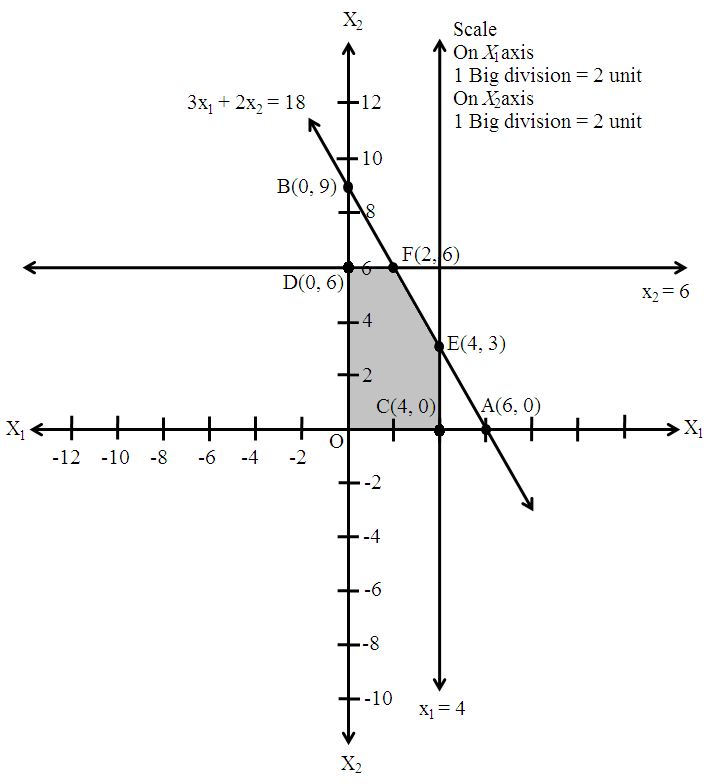
The line $3x_1 + 2x_2 = 18$ meets the coordinate axes at $A(6, 0)$ and $B(0, 9)$ respectively.
By joining these points we obtain the line $3X1 + 2x2 = 18.$
Clearly $(0, 0)$ satisfies the inequation $3x_1 + 2x_2 = 18.$
So the region in the plane which contain the origin represents the solution set of the inequation $3x_1 + 2x_2 \leq 18.$
Region represented by $x_1 \leq 4:$
The line $x_1 = 4$ is the line that passes through $C(4, 0)$ and is parallel to the $Y$ axis.
The region to the left of the line $x_1 = 4$ will satisfy the inequation $x_1 \leq 4.$
Region represented by $x_2 \leq 6:$
The line $x_2 = 6$ is the line that passes through $D(0, 6)$ and is parallel to the $X$ axis.
The region below the line $x_2 = 6$ will satisfy the inequation $X_2 \leq 6.$
Region represented by $x_1 \geq 0$ and $x_2 \geq 0:$
Since, every point in the first quadrant satisfies these inequations.
So, the first quadrant is the region represented by the inequations $x_1 \geq 0$ and $x_2 \geq 0.$
The feasible region determined by the system of constraints, $3x_1 + 2x_2 \leq 18, x_1 \leq 4, x_2 \leq 6, x_1 \geq 0$ and $x_2 \geq 0$ are as follows
  
Corner points are $O(0, 0), D(0, 6), F(2, 6), E(4, 3)$ and $C(4, 0).$
The values of the objective function at these points are given in the following table.
Points
Value of Z
$O(0, 0)$
$3(0) + 5(0) = 0$
$D(0, 6)$
$3(0) + 5(6) = 30$
$F(2, 6)$
$3(2) + 5(6) = 36$
$E(4, 3)$
$3(4) + 5(3) = 27$
$C(4, 0)$
$3(4) + 5(0) = 12$
We see that the maximum value of the objective function $Z$ is $36$ which is at $F(2, 6).$

Need a full question paper?

Generate a complete, print-ready paper with questions like this in minutes — across 16+ boards, with answer keys.

Start Generating Free

Similar questions

The probabilities of Virat become man of the match in $1^{st}, 2^{nd}$ and $3^{rd}$ match of India in world cup $2015$ are $\frac{3}{7},\frac{2}{7}$&$\frac{1}{7}$ respecitvely. If Virat got a man of the match in exactly one match, then what is the probability that he got man of the match in $3^{rd}$ match, is -
The antiderivative of every odd function is :
If $A$ and $B $ are independent events and $P(A) = 0.2, P(B)=0.3$ then the value of $P ($neither $A$ nor $B)$ will be
Evaluate $\begin{bmatrix}\text{x}^2&\text{x}^3&\text{x}^4\\\text{x}&\text{y}&\text{z}\\\text{x}^2&\text{x}^3&\text{x}^4\end{bmatrix}$ is:
If order of a matrix is $3 \times 3,$ then it is a?
A and B draw two cards each, one after another, from a pack of well-shuffled pack of 52 cards. The probability that all the four cards drawn are of the same suit is
Moving along the $ x-$ axis are two points with $x = 10 + 6t; \, x = 3 + {t^2}.$ The speed with which they are reaching from each other at the time of encounter is ........... $cm/sec$. ( $x$  is in $cm$ and $t$ is in seconds)
Out of the following points, how many points are satisfied the inequality $2 x-3 y>-5 ?$

$(1,1)(-1,1),(1,-1),(-1,-1),(-2,1)(2,-1),(-1,2)$ and $(-2,-1)$

For any $y \in \mathbb{R}$, let $\cot ^{-1}(y) \in(0, \pi)$ and $\tan ^{-1}(y) \in\left(-\frac{\pi}{2}, \frac{\pi}{2}\right)$. Then the sum of all the solutions of the equation $\tan ^{-1}\left(\frac{6 y}{9-y^2}\right)+\cot ^{-1}\left(\frac{9-y^2}{6 y}\right)=\frac{2 \pi}{3}$ for $0<|y|<3$, is equal to
$\int_{}^{} {\frac{{x - 1}}{{{{(x + 1)}^2}}}\;dx = } $