MCQ
By photoelectric effect, Einstein, proved
  • $E = h\nu$
  • B
    $K.E. = \frac{1}{2}m{v^2}$
  • C
    $E = m{c^2}$
  • D
    $E = \frac{{-Rh{c^2}}}{{{n^2}}}$

Answer

Correct option: A.
$E = h\nu$
a
(a)

Need a full question paper?

Generate a complete, print-ready paper with questions like this in minutes — across 16+ boards, with answer keys.
Start Generating Free

Similar questions

One bar magnet is kept in the direction of north-south such that its north pole is towards north.The direction of points of zero magnetic field is towards which side of the centre of the magnet:
Two long parallel wires are at a distance $2d$ apart. They carry steady equal currents flowing out of the plane of the paper, as shown. The variation of the magnetic field $B$ along the line $XX’$ is given by
An atom absorbs a photon of wavelength $500\,nm$ and emits another photon of wavelength $600\,nm$. The net energy absorbed by the atom in this process is $n \times 10^{-4}\,eV$. The value of $n$ is ............ [Assume the atom to be stationary during the absorption and emission process] $\left(\right.$Take $h =6.6 \times 10^{-34}\,Js$ and $\left.c =3 \times 10^8\,m / s \right)$
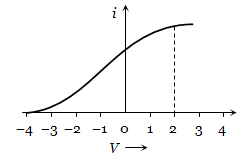
Figure represents the graph of photo current I versus applied voltage (V). The maximum energy of the emitted photoelectrons is
Choose the wrong statement:
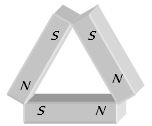
Three identical bar magnets each of magnetic moment $M$ are placed in the form of an equilateral triangle as shown. The net magnetic moment of the system is
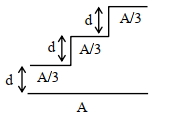
A capacitor is made of a tlat plate of area $A$ and a second plate having a stair-like structure as shown in figure. If the area of each stair is $\frac{A}{3}$ and the height is $\mathrm{d}$, the capacitance of the arrangement is:
In the Young's double slit experiment, the ratio of intensities of bright and dark fringes is 9. This means that
The desirable properties for making permanent magnets are:
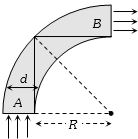
A rod of glass ($/mu = 1.5$) and of square cross section is bent into the shape shown in the figure. A parallel beam of light falls on the plane flat surface $A$ as shown in the figure. If $d$ is the width of a side and $R$ is the radius of circular arc then for what maximum value of $\frac{d}{R}$ light entering the glass slab through surface $A$ emerges from the glass through $B$