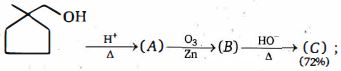
MCQ
By which mechanism does the above reaction proceed? 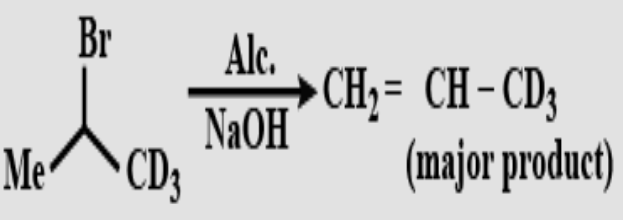
- A$E_1$
- ✓$E_2$
- C$\ce{E_1cb}$
- D$\gamma-$Elimination
Generate a complete, print-ready paper with questions like this in minutes — across 16+ boards, with answer keys.
Benzaldehyde, Acetaldehyde, Acetone, Acetophenone,Methanal, $4-$nitrobenzaldehyde, cyclohexane carbaldehyde.
${\left[ {Fe{{\left( {CN} \right)}_6}} \right]^{ - 4}}\xrightarrow{{MnO_4^ - /{H^ + }}}F{e^{ + 3}} + C{O_2} + NO_3^ - $