MCQ
C and Si both have the same lattice structure, having 4 bonding electrons in each. However, C is an insulator whereas Si is an intrinsic semiconductor. This is because
A. In case of C the valence band is not completely filled at absolute zero temperature.
B. In case of C the conduction band is partly filled even at absolute zero temperature.
C. The four bonding electrons in the case of C lie in the second orbit, whereas in the case of Si they lie in the third.
D. The four bonding electrons in the case of C lie in the third orbit, whereas for Si they lie in the fourth orbit.
  • A
    Option B
  • B
    Option A
  • C
    Option D
  • D
    Option C

Answer

(d) Option C
Explanation: ${ }^6 C : 1 s^2 2 s^2 2 p^2$
${ }^{14} Si : 1 s^2 2 s^2 2 p^6 3 s^2 3 p^2$
The energy required to take out an electron from the 3rd orbit of Si is much smaller than to take out an electron from the 2nd orbit of C. So, Si has a significant number of free electrons while C has a negligibly small number of free electrons.

Need a full question paper?

Generate a complete, print-ready paper with questions like this in minutes — across 16+ boards, with answer keys.

Start Generating Free

Similar questions

Electron beam used in an electron microscope, when accelerated by a voltage of $20\,kV$. has a de-Broglie wavelength of $\lambda_0$. If the voltage is increased to $40\,kV$. then the de-Broglie wavelength associated with the electron beam would be:
In optical instruments, the lenses are used to form images by:
According to Bohr hypothesis, discrete quantity is:
A cylindrical capacitor has two co-axial cylinders of length $20 \,cm$ and radii $2 r$ and $r$. Inner cylinder is given a charge $10 \,\mu C$ and outer cylinder a charge of $-10 \,\mu C$. The potential difference between the two cylinders will be
Substances in which the magnetic moment of a single atom is not zero, is known as
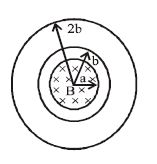
A uniform magnetic field $B$ that is perpendicular to the plane of the page now passes through the loops, as shown. The field is confined to a region of radius $a$ , where $a < b$ , and is changing at a constant rate. The induced emf in the wire loop of radius $b$ is $\varepsilon $. What is the induced emf in the wire loop of radius $2b$ 
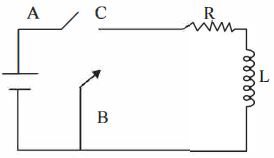
In the circuit shown here, the point '$C$' is kept connected to point '$A$' till the current flowing through the circuit becomes constant. Afterward, suddenly, point '$C$' is disconnected from point '$A$' and connected to point '$B$' at time $t = 0$. Ratio of the voltage across resistance and the inductor at $t = L/R$ will be equal to:
According to Maxwell’s hypothesis, a changing electric field gives rise to
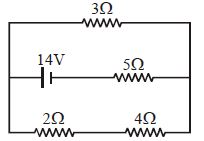
Find out current in $3\,\Omega $  resistance in given circuit
Power factor of an $L-R$ series circuit is $0.6$ and that of a $C-R$ series circuit is $0.5$. If the element ($L, C,$ and $R$) of the two circuits are joined in series the power factor of this circuit is found to be $1.$ The ratio of the resistance in the $L-R$ circuit to the resistance in the $C-R$ circuit is