Question
C, Si and Ge have same lattice structure. Why is $C$ insulator while $Si$ and Ge intrinsic semiconductors?

Answer

The 4 bonding electrons of $C , Si$ or Ge lie, respectively, in the second, third and fourth orbit. Hence, energy required to take out an electron from these atoms (i.e., ionisation energy $E_q$ ) will be least for Ge, followed by $Si$ and highest for $C$. Hence, number of free electrons for conduction in Ge and Si are significant but negligibly small for $C$.

Need a full question paper?

Generate a complete, print-ready paper with questions like this in minutes — across 16+ boards, with answer keys.
Start Generating Free

Similar questions

Which radiations do not produce photo-electric effect in metals?
Which part of electromagnetic spectrum is used in the working of radar?
A ferry boat loaded with rocks has to pass under a bridge. The maximum height of the rocks is slightly more than the height of the bridge so that the boat just fails to pass under the bridge. Should some of the rocks be removed or some more rocks be added?
On what components does diffraction depend?
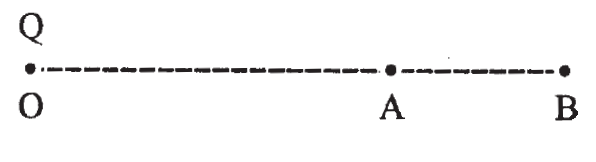
A point charge $Q$ is placed at point $O$ as shown in the figure. Is the potential difference $V_A-V_B$ positive, negative or zero, if $Q$ is (i) positive (ii) negative?
Consider the situation described in the previous problem. Show that the force on the sphere due to the light falling on it is the same even if the sphere is not perfectly absorbing.
Write the name of that part of electromagnetic spectrum with which electromagnetic waves of following wavelength associated. Write them in descending order of wavelength.
(a) $\lambda_1$ : used in treatment of muscular strains
(b) $\lambda_2$ : used in radio transmission
(c) $\lambda_3$ : used to detect fracture in bones
(d) $\lambda_4:$ are absorbed by ozone layer in the atmosphere
The ratio between flux binding and current I passing through a coil of N turns is called $\left(\frac{ N \phi}{2}\right)$
A plane electromagnetic wave is travelling along Z-axis in vacuum. What can you say about the electric field and magnetic field vectors?
Figure shows a glowing mercury tube. The intensities at point $A, B$ and $C$ are related as: