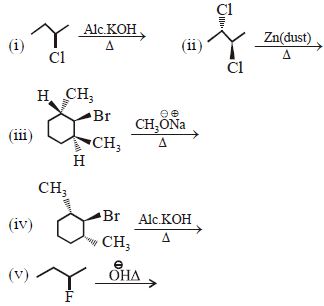
MCQ
$C_6H_{13}Br + OH^- \to C_6H_{13}OH + Br^-$ is an example of
- ANucleophilic addition
- ✓Nucleophilic substitution
- CElectrophilic addition
- DElectrophilic substitution
Generate a complete, print-ready paper with questions like this in minutes — across 16+ boards, with answer keys.
Statement I: Both $\left[\mathrm{Co}\left(\mathrm{NH}_3\right) 6\right]^{3+}$ and $\left[\mathrm{CoF}_6\right]^3$ complexes are octahedral but differ in their magnetic behaviour.
Statement II: $\left[\mathrm{Co}\left(\mathrm{NH}_3\right)\right]^{3+}$ is diamagnetic whereas $\left[\mathrm{CoF} \mathrm{F}_6\right]^{3-}$ is paramagnetic.
In the light of the above statements, choose the correct answer from the options given below:
$B$ reacts with Hydroxyl amine but does not give Tollen's test. Identify $A$ and $B$
|
List $- I$ (Products formed) |
List $- II$ (Reaction of carbonyl compound with) |
| $(a)$ Cyanohydrin | $(i)$ $NH _{2} OH$ |
| $(b)$ Acetal | $(ii)$ $RNH _{2}$ |
| $(c)$ Schiff's base | $(iii)$ alcohol |
| $(d)$ Oxime | $(iv)$ $HCN$ |
Choose the correct answer from the options given below: