Question
Calculate focal length of a spherical mirror from the following observations: object distance $\text{u} = (50.1 \pm 0.5)\text{cm}$ and image distance $\text{v} = (20.1 \pm0.2)\text{cm} .$

Answer

As $\frac{1}{\text{f}}=\frac{1}{\text{u}}+\frac{1}{\text{v}}=\frac{\text{v}+\text{u}}{\text{uv}}$ $\therefore\text{f}=\frac{\text{uv}}{\text{u}+\text{v}}=\frac{(50.1)(20.1)}{(50.1+20.1)}=14.3\text{cm}$ Also, $\frac{\Delta\text{f}}{\text{f}}=\pm\Big[\frac{\Delta\text{u}}{\text{u}}+\frac{\Delta\text{v}}{\text{v}}+\frac{\Delta\text{u}+\Delta\text{v}}{\text{u}+\text{v}}\Big]$ $=\pm\Big[\frac{0.5}{50.1}+\frac{0.2}{20.1}+\frac{0.5+0.2}{50.1+20.1}\Big]$ $\frac{\Delta\text{f}}{\text{f}}=\pm\Big[\frac{1}{100.2}+\frac{1}{100.5}+\frac{0.7}{70.2}\Big]$ $=\pm[0.0098+0.00995]+0.00997]$ $\Delta\text{f}=0.02990\times\text{f}=0.0299\times14.3$ $=0.428\text{cm}=0.4\text{cm}$ $\therefore\text{f}=(14.3\pm0.4)\text{cm}$

Need a full question paper?

Generate a complete, print-ready paper with questions like this in minutes — across 16+ boards, with answer keys.
Start Generating Free

Similar questions

If the Earth were to suddenly contract to $\frac{1}{\text{n}}^{\text{th}}$ of its present radius, without any change in its mass, then what will be the effect on the duration of the day?
At a time when the displacement is half the amplitude, what fraction of the total energy is kinetic and what fraction is the potential in S.H.M?
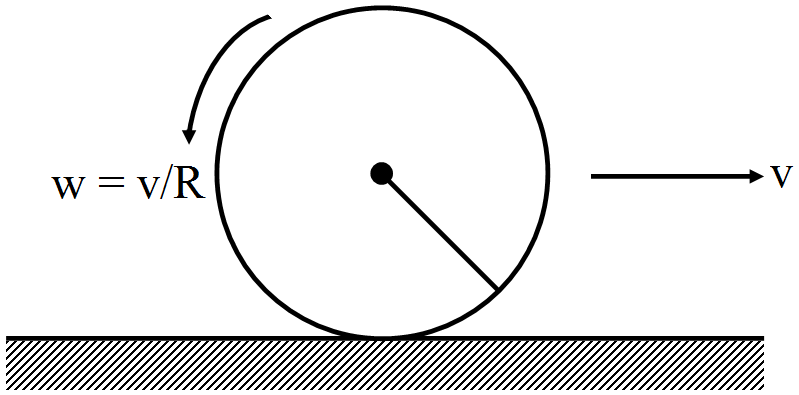
A solid sphere is set into motion on a rough horizontal surface with a linear speed v in the forward direction and an angular speed $\frac{\text{v}}{\text{R}}$ in the anticlockwise direction as shown in figure. Find the linear speed of the sphere:
  1. When it stops rotating.
  2. When slipping finally ceases and pure rolling starts.
List the salient features of heat radiations.
Reynold's number $N_R$(a dimensionless quantity) determines the condition of laminar flow of a viscous liquid through a pipe. $N_R$ is a function of the density of the liquid 'r', its average speed is 'y' and the coefficient of viscosity of the liquid is 'h'. If N, is given directly proportional to 'd' (the diameter of the pipe), show from dimensional consideration that $\text{N}_\text{R}\propto \frac{\text{dp}\rho}{\eta}$ the unit of '$\eta$' in SI system is kg $m^{-1}s^{-1}​​​​​​​$?
Find an expression for the maximum speed of circular motion of a car in a circular horizontal track of radius 'R'. The coefficient of static friction between the car tyres and the road along the surfaces is $\mu\text{s}.$
A person travelling by a car moving at 100km/h finds that his wristwatch agrees with the clock on a tower A. By what amount will his wristwatch lag or lead the clock on another tower B, 1000km (in the earth's frame) from the tower A when the car reaches there?
Find the centre of mass of three particles at the vertices of an equilateral triangle. The masses of the particles are 100g, 150g, and 200g respectively. Each side of the equilateral triangle is 0.5m long.
Find the binding energy per nucleon of $\text{ }^{197}_{79}\text{Au}$ if its atomic mass is 196.96u.
Show graphically how gravitational field strength varies with distance from the centre of earth, outwards. Give the relation also.