MCQ
Calculate radiation power for sphere whose temperature is $227^{\circ} C$ and radius $2\, m$ and emissivity $0.8$ (in $W$)
  • $1425$
  • B
    $1500$
  • C
    $1255$
  • D
    $1275$

Answer

Correct option: A.
$1425$
a
The expression of power is given as,

$P =\sigma AeT ^{4}$

Substitute the values.

$P =\left(5.67 \times 10^{-8}\right)\left(4 \pi \times 2^{2}\right)(0.8)(227+273)^{4}$

$\approx 1425 W$

Need a full question paper?

Generate a complete, print-ready paper with questions like this in minutes — across 16+ boards, with answer keys.
Start Generating Free

Similar questions

Ultrasonic, Infrasonic and audible waves travel through a medium with speeds ${V_u},\,{V_i}$ and ${V_a}$ respectively, then
Let the angle between two nonzero vectors $\overrightarrow A $ and $\overrightarrow B $ be $120^°$ and resultant be $\overrightarrow C $
A good lubricant should have
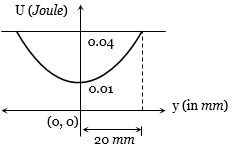
The variation of potential energy of harmonic oscillator is as shown in figure. The spring constant is
When a drop of oil is spread on a water surface, it displays beautiful colours in daylight because of:
  1. Disperson of light.
  2. Reflection of light.
  3. Polarization of light.
  4. Interference of light.
Efficiency $(\eta)$ of the heat engine in thermodynamics can be defined as:
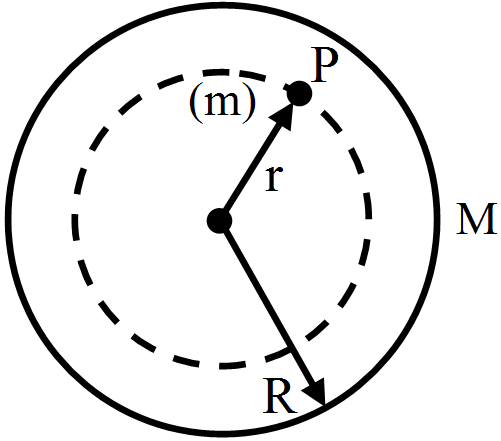
The force of attraction due to a hollow spherical shell of mass M, radius R and uniform density, on a point mass m situated inside it is:

A source of sound is moving with constant velocity of $20\, m/s$ emitting a note of frequency $1000 \,Hz.$ The ratio of frequencies observed by a stationary observer while the source is approaching him and after it crosses him will be

(Speed of sound $v = 340\, m/s$)

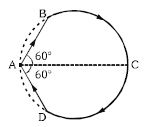
Consider a circle of radius $42\  cm$. An insect crawls with uniform speed of $1.3\  cm/s$ along the chord $AB$ then along the circular arc $BCD$ to reach point $D$ and then following cord $DA$ to reach finally $A$. Time spend by the insect to crawl from $A$ to $A$ is closest to    ......... $\sec$
An ideal gas has an initial pressure of $3$ pressure units and an initial volume of $4$ volume units. The table gives the final pressure and volume of the gas (in those same units) in four, processes. Which processes start and end on the same isotherm

$\begin{array}{|c|c|c|c|c|} \hline & A & B & C & D \\ \hline P & 5 & 4 & 12 & 6 \\ \hline V & 7 & 6 & 1 & 3 \\ \hline \end{array}$