MCQ
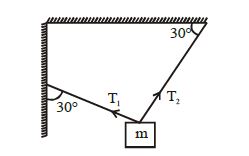
Calculate $T_1$ and $T_2$
  • $\frac{{\sqrt 3 }}{2}mg,\frac{{mg}}{2}$
  • B
    $mg,\frac{{\sqrt 3 }}{2}mg$
  • C
    $\frac{{\sqrt 3 }}{2}mg,\frac{{\sqrt 3 }}{2}mg$
  • D
    $\frac{{mg}}{2},\frac{{mg}}{2}$

Answer

Correct option: A.
$\frac{{\sqrt 3 }}{2}mg,\frac{{mg}}{2}$
a
$\frac{\mathrm{T}_{1}}{\sin 120^{\circ}}=\frac{\mathrm{Mg}}{\sin 90^{\circ}}$

$\mathrm{T}_{1}=\frac{\sqrt{3}}{2} \mathrm{Mg}$

$\frac{\mathrm{T}_{2}}{\sin 150^{\circ}}=\frac{\mathrm{Mg}}{\sin 90^{\circ}}$

$\mathrm{T}_{2}=\frac{\mathrm{Mg}}{2}$

Need a full question paper?

Generate a complete, print-ready paper with questions like this in minutes — across 16+ boards, with answer keys.
Start Generating Free

Similar questions

Consider two physical quantities A and B related to each other as $E=\frac{B-x^2}{A t}$ where $E, x$ and $t$ have dimensions of energy, length and time respectively. The dimension of $A B$ is
An aeroplane is flying with a uniform speed of $100\, m/s$ along a circular path of radius $100 m$. the angular speed of the aeroplane will be ......... $rad/sec$
A force of ${10^3}$ newton stretches the length of a hanging wire by $1$ millimetre. The force required to stretch a wire of same material and length but having four times the diameter by $1$ millimetre is
Let $\gamma_1$ be the ratio of molar specific heat at constant pressure and molar specific heat at constant volume of a monoatomic gas and $\gamma_2$ be the similar ratio of diatomic gas. Considering the diatomic gas molecule as a rigid rotator, the ratio, $\frac{\gamma_1}{\gamma_2}$ is
In a stationary wave, all particles are
A carpenter has constructed a toy as shown in the adjoining figure. If the density of the material of the sphere is $12$ times that of cone, the position of the centre of mass of the toy is given by
$A$ particle of mass m is constrained to move on $x$ -axis. $A$ force $F$ acts on the particle. $F$ always points toward the position labeled $E$. For example, when the particle is to the left of $E, F$ points to the right. The magnitude of $F$ is a constant $F$ except at point $E$ where it is zero. The system is horizontal. $F$ is the net force acting on the particle. The particle is displaced a distance $A$ towards left from the equilibrium position $E$ and released from rest at $t = 0.$ Velocity - time graph of the particle is
A force of $5 \,N$ acts on a body of weight $9.8 \,N$. What is the acceleration produced in $m/{\sec ^2}$
If the Earth losses its gravity, then for a body
Which one of the following is not a unit of young's modulus