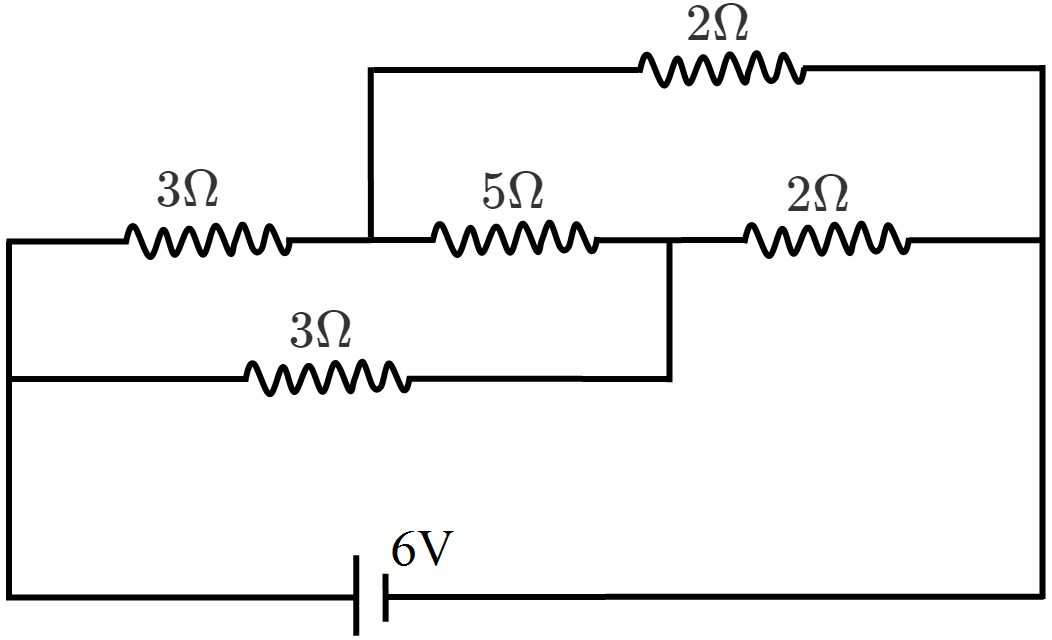
Calculate the current drawn from the battery in the given network shown here. State Kirchhoff’s loop law and name the law on which it is based.
Download our app for free and get started
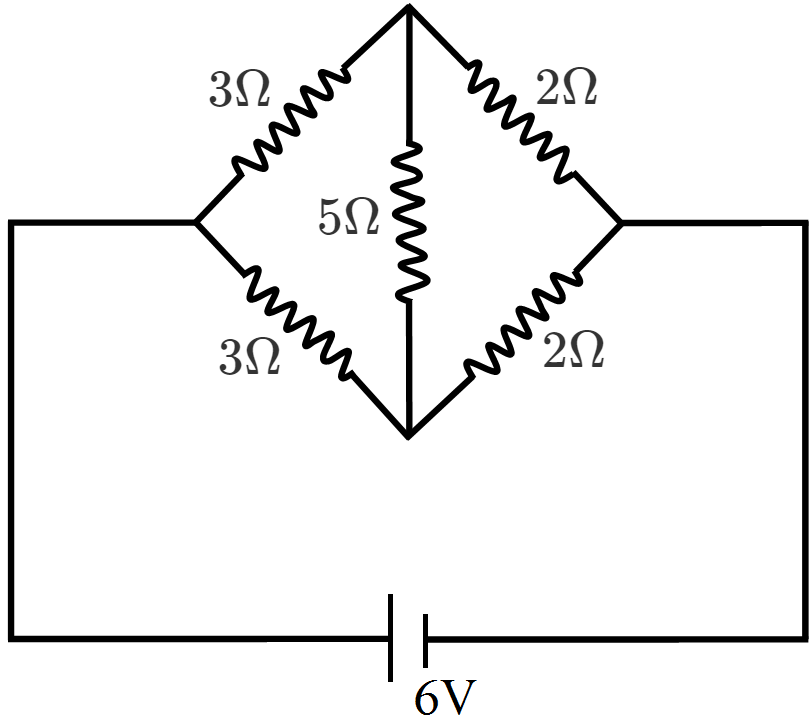
The equivalent circuit is as shown in figure alongside. [$\therefore$ Bridge is in balanced condition, no current flows through $5\Omega$ resistance] $\frac{1}{\text{R}}=\frac{1}{5}+\frac15\text{R}=5\Omega$
Current in the circuit $=\frac{6}{2.5}\text{A}=2.4\text{A}$ Kirchhoff’s Loop Law: The algebraic sum of potential differences of different circuit elements of a closed circuit (or mesh) is zero. This law is based on law of conservation of energy.
Download our app
and get started for free
Experience the future of education. Simply download our apps or reach out to us for more information. Let's shape the future of learning together!No signup needed.*
Figure shows a potentiometer circuit for comparison of two resistances. The balance point with a standard resistor $\text{R}=10.0\ \Omega$ is found to be $58.3 \ cm,$ while that with the unknown resistance $X$ is $68.5 \ cm$. Determine the value of $X$. What might you do if you failed to find a balance point with the given cell of emf $\varepsilon?$
An electric bulb, when connected across a power supply of 220V, consumes a power of 60W. If the supply drops to 180V, what will be the power consumed? If the supply is suddenly increased to 240V, what will be the power consumed?
An ideal battery sends a current of 5A in a resistor. When another resistor of value $10\Omega$ is connected in parallel, the current through the battery is increased to 6A. Find the resistance of the first resistor.
A (i) series (ii) parallel combination of two given resistors is connected, one by one, across a cell. In which case will the terminal potential difference, across the cell have a higher value?
Write the principle of working of a potentiometer. Describe briefly, with the help of a circuit diagram, how a potentiometer is used to determine the internal resistance of a given cell.
In a metre bridge, the balance point is found at a distance $l_1$ with resistances R and S as shown in the figure.
An unknown resistance X is now connected in parallel to the resistance S and the balance point is found at a distance $l_2$. Obtain a formula for X in terms of $l_1$, $l_2$ and S.
Define relaxation time of the free electrons drifting in a conductor. How is it related to the drift velocity of free electrons? Use this relation to deduce the expression for the electrical resistivity of the material.