Question
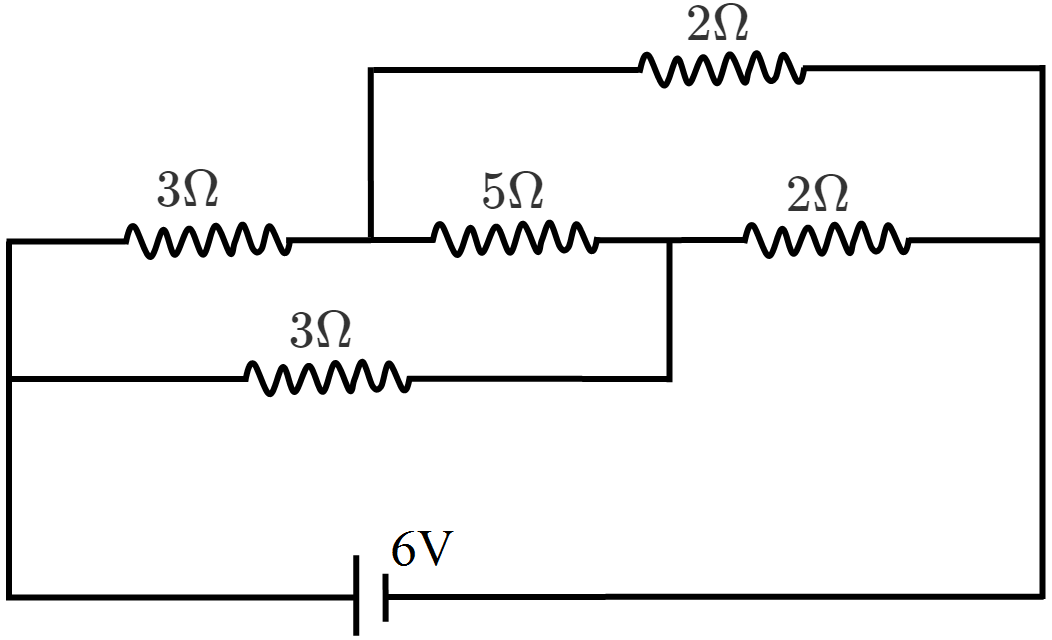
Calculate the current drawn from the battery in the given network shown here. State Kirchhoff’s loop law and name the law on which it is based.
Answer

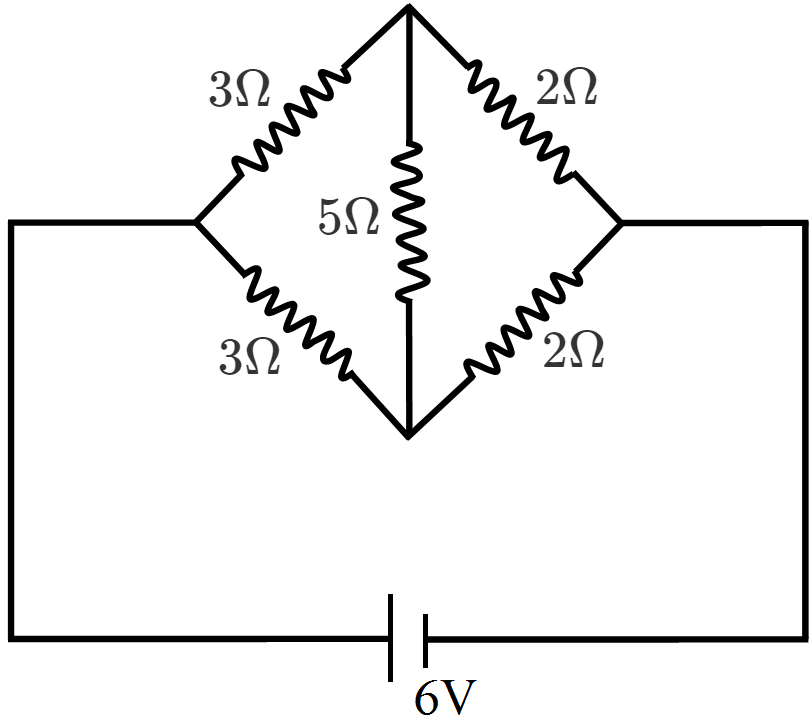
The equivalent circuit is as shown in figure alongside. [$\therefore$ Bridge is in balanced condition, no current flows through $5\Omega$ resistance] $\frac{1}{\text{R}}=\frac{1}{5}+\frac15\text{R}=5\Omega$
Current in the circuit $=\frac{6}{2.5}\text{A}=2.4\text{A}$ Kirchhoff’s Loop Law: The algebraic sum of potential differences of different circuit elements of a closed circuit (or mesh) is zero. This law is based on law of conservation of energy.

Need a full question paper?

Generate a complete, print-ready paper with questions like this in minutes — across 16+ boards, with answer keys.
Start Generating Free

Similar questions

The potential V due to a charge distribution at a point (x, y) is given by $V = -x^2 + 3y$
Calculate the electric field, in magnitude and direction, due to this charge configuration at the point (1, 1).
A beam of light consisting of two wavelengths, $650 \ nm$ and $520 \ nm,$ are used to obtain interference fringes in a Young's double slit experiment.
$a$. Find the distance of the third bright fringe on the screen from the central maximum for wavelength $650 \ nm.$
$b$. What is the least distance from the central maximum where the bright fringes due to both the wavelengths coincide?
Explain the refraction of a plane wave by
(a) a thin prism
(b) a convex lens and
(c) reflection of a plane wave by a concave mirror.
$a.$ Using the Bohr's model, calculate the speed of the electron in a hydrogen atom in the $n = 1, 2$ and $3$ levels.
$b.$ Calculate the orbital period in each of these levels.
  1. Write the functions of three segments of a transistor.
  2. Draw the circuit diagram for studying the input and output characteristics of n-p-n transistor in common emitter configuration. Using the circuit, explain how input, output characteristics are obtained.
  1. Describe briefly, with the help of suitable diagram, how the transverse nature of light can be demonstrated by the phenomenon of polarization.
  2. When unpolarized light passes from air to a transparent medium, under what condition does the reflected light get polarized?
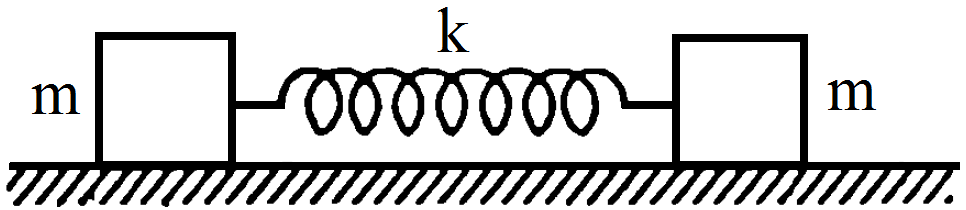
Consider the situation shown in figure Show that if the blocks are displaced slightly in opposite directions and released, they will execute simple harmonic motion. Calculate the time period.
A light ray falling at an angle of 45° with the surface of a clean slab of ice of thickness 1m is refracted into it at an angle of 30°. Calculate the time taken by the light rays, to cross the slab. Speed of light in vacuum $= 3 \times 10^8m/s$
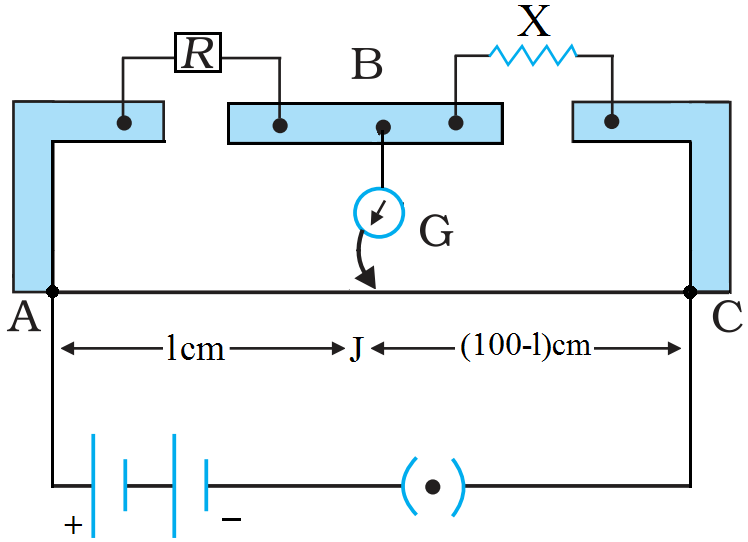
A resistance $\text{R}=4\Omega$ is connected to one of the gaps in a meter bridge, which uses a wire of length 1m. An unknown resistance $\text{x}>4\Omega$ is connected in the other gap as shown in the figure. The balance point is noticed at ‘l’ cm from the positive end of the battery. On interchanging R and X, it is found that the balance point further shifts by 20cm (away from the end A). Neglecting the end correction calculate the value of unknown resistance ‘X’ used.
Calculate the magnetic dipole moment corresponding to the motion of the electron in the ground state of a hydrogen atom.