Question
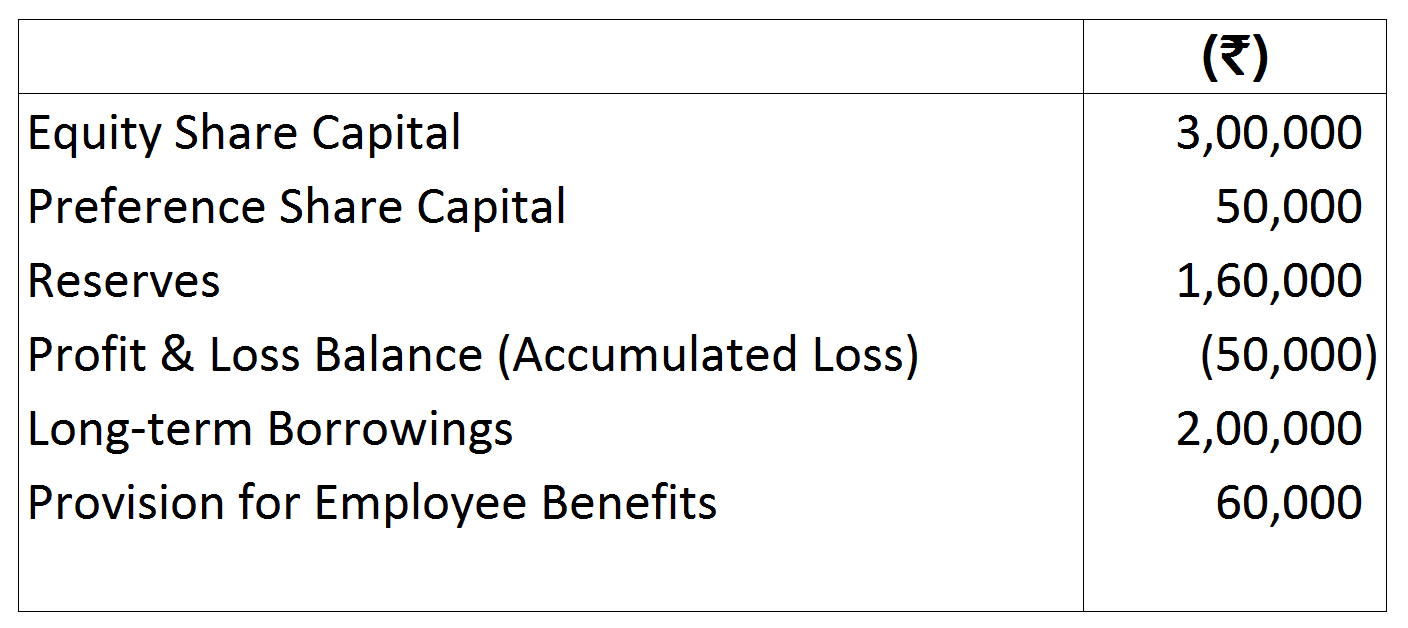
Calculate the Debt Equity Ratio from the following:-

Answer

Debt - Equity Ratio $=\frac{\text{Debt}}{\text{Equity}}\text{ or }\frac{\text{Long term Debts}}{\text{Shareholder's Funds}}$
Long term Debts = Long term Borrowings + Long term Provisions (i.e. Provision for Employee Benefits).
= ₹ 2,00,000 + ₹ 60,000 = ₹ 2,60,000
Shareholder's Funds = Equity Share Capital + Preference Share Capital + Reserves - Profit & Loss Balance
= ₹ 3,00,000 + ₹ 50,000 + ₹ 1,60,000 - ₹ 50,000
= ₹ 4,60,000
Debt Equity Ratio $=\frac{₹\ 2,60,000}{₹\ 4,60,000}=0.57:1.$

Need a full question paper?

Generate a complete, print-ready paper with questions like this in minutes — across 16+ boards, with answer keys.
Start Generating Free

Similar questions

Total Debt ₹ 40,00,000; Share Capital ₹ 15,00,000; Reserve and Surplus ₹ 8,00,000; Current Liabilities ₹ 5,00,000; Working Capital ₹ 7,00,000. Calculate Total Assets to Debt Ratio.
Vishwas Ltd. issued 2,000; 9% Debentures of ₹ 100 each payable as follows:
₹ 25 on application; ₹ 25 on allotment and ₹ 50 on first and final call.
Applications were received for all the debentures along with the application money did allotment was made. Call money was also received on the due date.
Pass necessary Journal entries in the books of the company.
Under what main heads and sub-heads, will the following items appear in the balance sheet of a company as per Schedule III, Part I of the Companies Act, 2013
i. Mining rights
ii. Encashment of employees earned leave payable on retirement
iii. Vehicles

Find out the value of Closing Inventory, if Closing Inventory is ₹ 16,000 more than the Opening Inventory.
Give the classification of the Cash Flow for preparing Cash Flow Statement.
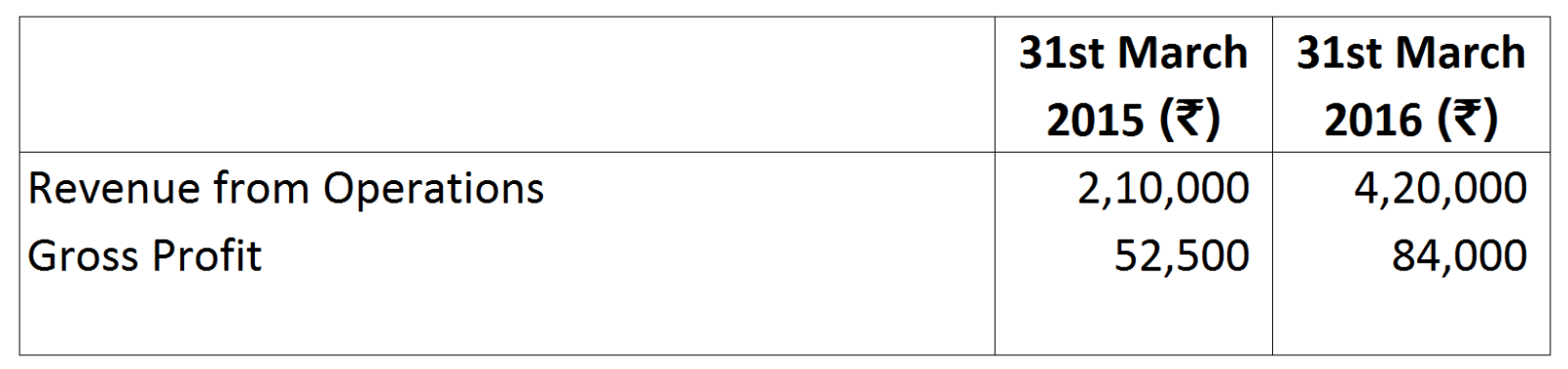
The following figures have been taken from the published accounts of G. Associates for the two successive years:
Comment upon the profitability for the two years.
Total Debt ₹ 12,00,000; Current Liabilities ₹ 4,00,000; Capital Employed ₹ 12,00,000. Calculate Total Assets to Debt Ratio.
Journalise the following:
Y Ltd. forfeited 400 shares of ₹ 100 each, issued at a premium of ₹ 5 per share (to be paid at the time of allotment) for non-payment of a first call of ₹ 20 per share. The second and final call of ₹ 20 has not yet been called. Out of these, 100 shares were re-issued on fully paid-up for ₹ 110 per share.
150 shares of ₹ 10 each issued at a premium of ₹ 4 per share payable with allotment were forfeited for non-payment of allotment money of ₹ 8 per share including premium. The first and final call of ₹ 4 per Pass Journal entries in the books of X Ltd. for the above.
State the major head under which the following items will be shown in the Statement of Profit and Loss of a Company:
  1. Loss on Issue of Debentures written off.
  2. Dividend received.
  3. Sale of Services.
  4. Contribution to Gratuity fund.
  5. Medical Expenses.
  6. Bank Charges.
  7. Carriage Outwards.
  8. Bad-Debts written off.