Question
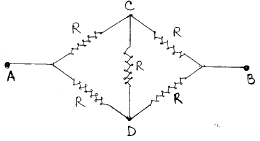
  1. Calculate the equivalent resistance of the given electrical network between points A and B.
  2. Also calculate the current through CD and ACB, if a 10 V d.c. source is connected between A and B, and the value of R is assumed as 2 Ω.

Answer

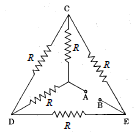
  1. Circuit:

Calculation of $\frac{1}{\text{R}_{AB}} = \frac{1}{2\text{R}} + \frac{1}{2\text{R}}\text{ or }\text{R}_{AB} = \text{R}$

  1. Current through CD = 0

Current through ACB = $\frac{10\text{V}}{4\Omega} = 2.5\text{A}.$

Need a full question paper?

Generate a complete, print-ready paper with questions like this in minutes — across 16+ boards, with answer keys.
Start Generating Free

Similar questions

Using Gauss's law obtain the expression for the electric field due to a uniformly charged thin spherical shell of radius R at a point outside the shell. Draw a graph showing the variation of electric field with r, for r > R and r < R.
In the original Fizeau method, the light travelled 8.6km and then returned. What could be the difficulty if this distance is taken as 8.6m?
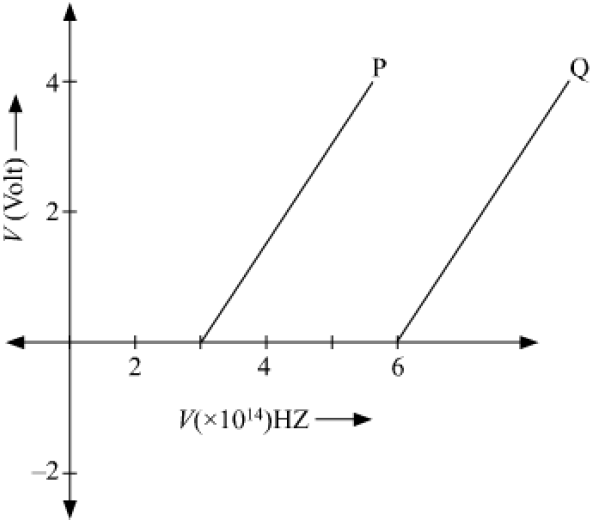
In the study of a photoelectric effect the graph between the stopping potential V and frequency v of the incident radiation on two different metals P and Q is shown below

  1. Which one of the two metals has higher threshold frequency?
  2. Determine the work function of the metal which has greater value.
  3. Find the maximum kinetic energy of electron emitted by light of frequency 8 × 10¹⁴ Hz for this metal.
  1. Consider an arbitrary electrostatic field configuration. A small test charge is placed at a null point (i.e., where E = 0) of the configuration. Show that the equilibrium of the test charge is necessarily unstable.
  2. Verify this result for the simple configuration of two charges of the same magnitude and sign placed a certain distance apart.
In a pure semiconductor, the number of conduction electrons is 6 × 10¹⁹ per cubic metre. How many holes are there in a sample of size 1cm × 1cm × 1mm?
A circular coil of radius $10 cm , 500$ turns and resistance $2 \Omega$ is placed with its plane perpendicular to the horizontal component of the earth's magnetic field. It is rotated about its vertical diameter through $180^{\circ}$ in $0.25 s$. Estimate the magnitudes of the emf and current induced in the coil. Horizontal component of the earth's magnetic field at the place is $3.0 \times 10^{-5} T$.
“Gauss’s law in electrostatics is true for any closed surface, no matter what its shape or size is”. Justify this statement with the help of a suitable example.

A parallel plate capacitor, each with plate area A and separation d, is charged to a potential difference V. The battery used to charge it is then disconnected. A dielectric slab of thickness d and dielectric constant K is now placed between the plates. What change, if any, will take place in.

  1.  Charge on the plates.
  2. Electric field intensity between the plates.
  3. Capacitance of the capacitor.
What is the radius of curvature of the parabola traced out by the projectile in the previous problem at a point where the particle velocity makes an angle $\frac{\theta}{2}$ with the horizontal?
  1. Define ‘activity’ of a radioactive substance.
  2. Two different radioactive elements with half lives T1 and T2 have N1 and N2 undecayed atoms respectively present at a given instant. Derive an expression for the ratio of their activities at this instant in terms of N1 and N2.