Question
Calculate the force with which you attract the earth.

Answer

Consider that a man is standing on the surface of the Earth.

Force acting on the man = mg

Here, m = mass of the man and g = acceleration due to gravity on the surface of earth (= 10m/s2)

Assume that the mass of the man is equal to 65kg.

Then F = W = mg = 65 × 10 = 650N = force acting on the man

$\therefore$ By Newton's third law (action-reaction are always equal), the man is also attracting the earth with a force of 650N in the opposite direction.

Need a full question paper?

Generate a complete, print-ready paper with questions like this in minutes — across 16+ boards, with answer keys.

Start Generating Free

Similar questions

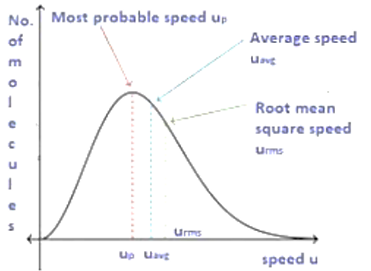
Root mean square velocity (RMS value)is the square root of the mean of squares of the velocity of individual gas molecules and the Average velocity is the arithmetic mean of the velocities of different molecules of a gas at a given temperature.
Image
1. Moon has no atmosphere because:
(a) the escape velocity of the moon’s surface is more than the r.m.s velocity of all molecules
(b) it is far away from the surface of the earth
(c) the r.m.s. velocity of all the gas molecules is more than the escape velocity of the moon’s surface
(d) its surface temperature is $10^{\circ} C$
2. For an ideal gas, $\frac{C_P}{C_V}$ is
(a) $\leq 1$    (b) none of these    (c) $>1$    (d) $<1$
3. The root means square velocity of hydrogen is $\sqrt{5}$ times that of nitrogen. If $T$ is the temperature of the gas then:
(a) $T\left(H_2\right)=T\left(N_2\right)$    (b) $T \left( H _2\right)< T \left( N _2\right)$
(c) $T \left( H _2\right) \neq T \left( N _2\right)$    (d) $T \left( H _2\right)> T \left( N _2\right)$
4. Suppose the temperature of the gas is tripled and $N _2$ molecules dissociate into an atom. Then what will be the rms speed of atom:
(a) $v_0 \sqrt{2}$    (b) $v_0 \sqrt{6}$    (c) $v_0 \sqrt{3}$    (d) $v_0$
OR
The velocities of the molecules are $v , 2 v , 3 v , 4 v \& 5 v$. The RMS speed will be:
(a) 11 v    (b) $v (12)^{11}$   (c) v    (d) $v (11)^{12}$
A person goes to bed at sharp 10:00 pm every day. Is it an example of periodic motion? If yes, what is the time period? If no, why?
A kid of mass M stands at the edge of a platform of radius R which can be freely rotated about its axis. The moment of inertia of the platform is I. The system is at rest when a friend throws a ball of mass m and the kid catches it. If the velocity of the ball is v horizontally along the tangent to the edge of the platform when it was caught by the kid, find the angular speed of the platform after the event.
Read the passage given below and answer the following questions from 1 to 5.
What happens if a pulse or a wave meets a boundary? If the boundary is rigid, pulse travelling along a stretched string and being reflected by the boundary. Assuming there is no absorption of energy by the boundary, the reflected wave has the same shape as the incident pulse i.e. crest is reflected as crest and trough as trough but it suffers a phase change of π or 1800 on reflection. This is because the boundary is rigid and the disturbance must have zero displacement at all times at the boundary. By the principle of superposition, this is possible only if the reflected and incident waves differ by a phase of π, so that the resultant displacement is zero. This reasoning is based on boundary condition on a rigid wall. If on the other hand, the boundary point is not rigid but completely free to move (such as in the case of a string tied to a freely moving ring on a rod), the reflected pulse has the same phase and amplitude (assuming no energy dissipation) as the incident pulse. The net maximum displacement at the boundary is then twice the amplitude of each pulse. An example of non- rigid boundary is the open end of an organ pipe. To summaries, a travelling wave or pulse suffers a phase change of π on reflection at a rigid boundary and no phase change on reflection at an open boundary. We considered above reflection at one boundary. But there are familiar situations (a string fixed at either end or an air column in a pipe with either end closed) in which reflection takes place at two or more boundaries. In a string, for example, a wave travelling in one direction will get reflected at one end, which in turn will travel and get reflected from the other end. This will go on until there is a steady wave pattern set up on the string. Such wave patterns are called standing waves or stationary waves.
  1. A travelling wave or pulse suffers a phase change of π on reflection at:
  1. A rigid boundary
  2. Open boundary
  1. A travelling wave or pulse suffers no phase change on reflection at:
  1. A rigid boundary
  2. Open boundary
  1. What are stationary waves?
  1. Write a note on reflection of travelling wave from rigid boundary.
  1. Write a note on reflection of travelling wave from open boundary.
An AC source is connected to a diode and a resistor in series. Is the current thorough the resistor AC or DC?
A collision experiment is done on a horizontal table kept in an elevator. Do you expect a change in the results if the elevator is accelerated up or down because of the noninertial character of the frame?
A short magnet produces a deflection of 37° in a deflection magnetometer in Tan-A position when placed at a separation of 10cm from the needle. Find the ratio of the magnetic moment of the magnet to the earth's horizontal magnetic field.
How will you ‘weigh the sun’, that is estimate its mass ? The mean orbital radius of the earth around the sun is 1.5 × 10⁸ km.
A spring balance has a scale that reads from 0 to 50 kg . The length of the scale is 20 cm . A body suspended from this balance, when displaced and released, oscillates with a period of 0.6 s . What is the weight of the body ?
Read the passage given below and answer the following questions from  1 to 5.
In general, the errors in measurement can be broadly classified as (a) systematic errors and (b) random errors.
Systematic errors: The systematic errors are those errors that tend to be in one direction, either positive or negative. Some of the sources of systematic errors are:
(a) Instrumental errors that arise from the errors due to imperfect design or calibration of the measuring instrument, zero error in the instrument, etc. For example, the temperature graduations of a thermometer may be inadequately calibrated (it may read 104 °C at the boiling point of water at STP whereas it should read 100 °C); in a vernier calipers the zero mark of vernier scale may not coincide with the zero mark of the main scale, or simply an ordinary metre scale may be worn off at one end.
(b) Imperfection in experimental technique or procedure to determine the temperature of a human body, a thermometer placed under the armpit will always give a temperature lowers than the actual value of the body temperature.
(c) Personal errors that arise due to an individual’s bias, lack of proper setting of the apparatus or individual’s carelessness in taking observations without observing proper precautions, etc. For example, if you, by habit, always hold your head a bit too far to the right while reading the position of a needle on the scale, you will introduce an error due to parallax.Systematic errors can be minimized by improving experimental techniques, selecting better instruments and removing personal bias as far as possible. For a given set-up, these errors may be estimated to a certain extent and the necessary corrections may be applied to the readings.
Random errors:The random errors are those errors, which occur irregularly and hence are random with respect to sign and size. These can arise due to random and unpredictable fluctuations in experimental conditions (e.g. unpredictable fluctuations in temperature, voltage), personal (unbiased) errors by the observer taking readings, etc. For example, when the same person repeats the same observation, it is very likely that he may get different readings every time.
Least count error: The smallest value that can be measured by the measuring instrument is called its least count. All the readings or measured values are good only up to this value. The least count error is the error associated with the resolution of the instrument.
  1. The errors due to imperfect design or calibration of the measuring instrument:
  1. Instrumental error
  2. Random error
  3. Least count error
  4. None of the above
  1. The errors which occur irregularly
  1. Instrumental error
  2. Personal error
  3. Random error
  4. None of these
  1. Write a note on least count error
  1. Write a note on random error
  1. Write a note on systematic error