Question
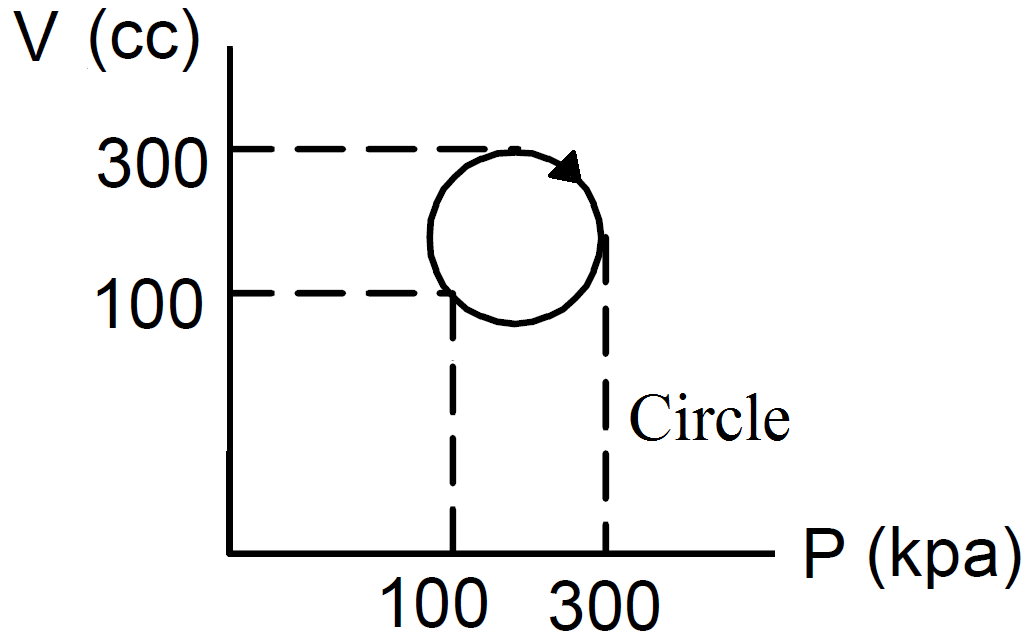
Calculate the heat absorbed by a system in going through the cyclic process shown in figure.
Answer


Heat absorbed = work done = Area under the graph

In the given case heat absorbed = area of the circle

$= \pi \times 10^4 × 10^{-6} \times 10^3 = 3.14 \times 10 = 31.4\text{J}$

Need a full question paper?

Generate a complete, print-ready paper with questions like this in minutes — across 16+ boards, with answer keys.
Start Generating Free

Similar questions

Because of the friction between the water in oceans with the earth's surface, the rotational kinetic energy of the earth is continuously decreasing. If the earth's angular speed decreases by 0.0016rad/ day in 100 years, find the average torque of the friction on the earth. Radius of the earth is 6400km and its mass is 6.0 × 1024kg.
A circular road of radius 50m has the angle of banking equal to 30°. At what speed should a vehicle go on this road so that the friction is not used?
The plates of a parallel-plate capacitor are made of circular discs of radii 5.0cm each. If the separation between the plates is 1.0mm, what is the capacitance?
Which of the following length measurement is most accurate and why?
  1. 4.00cm.
  2. 0.004mm.
  3. 40.00cm.
A block of mass 5.0kg slides down an incline of inclination 30° and length 10m. Find the work done by the force of gravity.
A manometer reads the pressure of a gas in an enclosure as shown in Fig.(a) When a pump removes some of the gas, the manometer reads as in Fig. (b) The liquid used in the manometers is mercury and the atmospheric pressure is 76cm of mercury.
Give the absolute and gauge pressure of the gas in the enclosure for cases (i) and (ii) in units of cm of mercury.
How would the levels change in case (i) if 13.6cm of water (immiscible with mercury) are poured into the right limb of the manometer? (Ignore the small change in volume of the gas.)

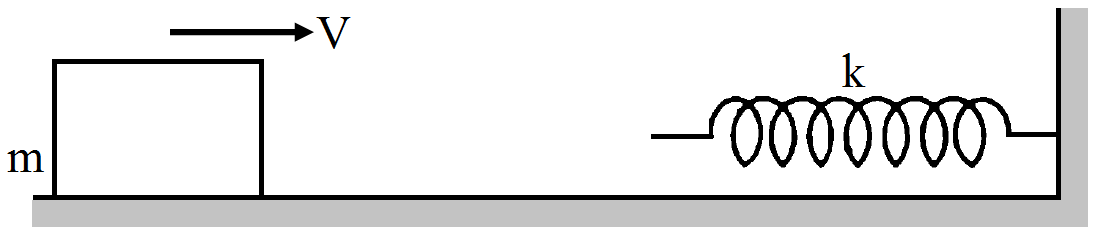
A block of massip, sliding on a smooth horizontal surface with a velocity $\vec{\text{v}}$ meets a long horizontal spring fixed at one end and having spring constant k as shown in figure. Find the maximum compression of tin spring. Will the velocity of the block be the same $\vec{\text{v}}$ when it comes back to the original position shown?

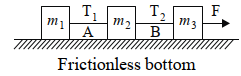
In the figure, three blocks are tied with two strings $A$ and $B . m_1=10 kg, m_2=5 kg, m_3=5 kg$. The bottom is frictionless. If $m _3$ is pulled to the right by applying a horizontal force of 50 N then calculate the tension in the strings.
Image
A wire is cut to half its length. For a given load what would be the effect on increase in its length? What would be the effect on the maximum load that it can bear?
Acceleration is called as rate of change of velocity. Suppose we call rate of change of acceleration SLAP, what is the unit of SLAP?