Question
Calculate the minimum energy needed to separate a neutron from a nucleus with $Z$ protons and $N$ neutrons it terms of the masses $\ce{M{Z.N,} M_Z_{N-1}}$ and the mass of the neutron.

Answer

$\text{E}_2\text{N}=\text{E}_{\text{Z,N}-1}+\text{ }^1_0\text{n}.$
Energy released $= ($Initial Mass of nucleus $-$ Final mass of nucleus$) \ \ce{c^2 = (M_{Z.N-1} + M_0 - M_{ZN})c^2}$.

Need a full question paper?

Generate a complete, print-ready paper with questions like this in minutes — across 16+ boards, with answer keys.
Start Generating Free

Similar questions


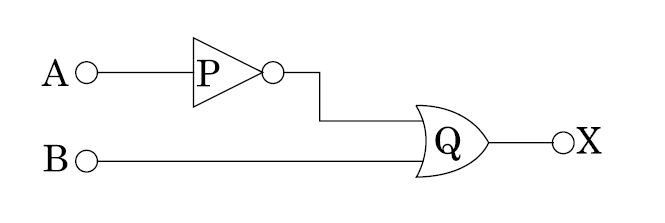
Name the logic gates marked P and Q in the given logic circuit.
If several lenses of focal lengths $f_1, f_2, f_3 \ldots$ are kept in contact with each other, then what will be the effective focal length of this combination?
An electron, an alpha particle and a proton have the same kinetic energy. Which one of these particles has the largest de-Broglie wavelength?
Write the relationship between angle of incidence ‘i’, angle of prism ‘A’ and angle of minimum deviation for a triangular prism.
Welders wear special goggles or face masks with glass windows to protect their eyes from electromagnetic radiations. Name the radiations and write the range of their frequency.
Frictional force between solids operates even when they do not move with respect to each other. Do we have viscous force acting between two layers even if there is no relative motion?
In a rotating body, $\text{a}=\alpha\text{r}$ and $\text{v}=\omega\text{r}.$ Thus $\frac{\text{a}}{\alpha}=\frac{\text{v}}{\omega}.$ Can a co you use the theorems of ratio and proportion studied in algebra so as to write$\frac{\text{a}+\alpha}{\text{a}-\alpha}=\frac{\text{v}+\omega}{\text{v}-\omega}$
A proton and an electron travelling along parallel paths enter a region of uniform magnetic field, acting perpendicular to their paths. Which of them will move in a circular path with higher frequency?
One Coulomb charge is equal to how many electrons?
A rod of rest length L moves at a relativistic speed. $\text{L}=\frac{\text{L}}{\curlyvee}.$ Let Its length:
  1. Must be equal to L.
  2. May be equal to L.
  3. May be more than L' but less than L.
  4. May be more than L.