Question
Calculate the stress developed inside a tooth cavity filled with copper when hot tea at temperature of 57°C is drunk. You can take body (tooth) temperature to be 37°C and a = 1.7 × 10⁻⁵/°C bulk modulus for copper = 140 × 109N/ m2

Answer

According to the problem, decrease in temperature
$(\Delta\text{t})=57-37=20^\circ\text{C}$
Coefficient of linear expansion
$(\alpha)=1.7\times^{-5}/^{\circ}\text{C}$
Bulk modulus for copper $(\text{B})=140\times10^9\text{N/ m}^2$
Coefficient of cubical expansion,
$(\gamma)=3\alpha=5.1\times10^{-5}/^\circ\text{C}$
Let initial volume of the cavity be V and its volume increases by $\Delta\text{V}$ due to increase in temperature.
$\therefore\ \Delta\text{V}=\gamma\text{V}\Delta\text{t}$
$\Rightarrow\ \frac{\Delta\text{V}}{\text{V}}=\gamma\Delta\text{t}$
We know, $\text{B}=\frac{\text{stress}}{\text{volume strain}}$
$\therefore$ Thermal stress $=\text{B}\times\Big(\frac{\Delta\text{V}}{\text{V}}\Big)=\text{B}(\gamma\Delta\text{T})$
$=\text{B}(3\alpha\Delta\text{T})\ \ (\because\gamma=3\alpha)$
$=140\times10^9\times3\times1.7\times10^{-5}\times20$
$=1.428\times10^8\text{Nm}^{-2}$
This is about 103 times of atmospheric pressure.

Need a full question paper?

Generate a complete, print-ready paper with questions like this in minutes — across 16+ boards, with answer keys.
Start Generating Free

Similar questions

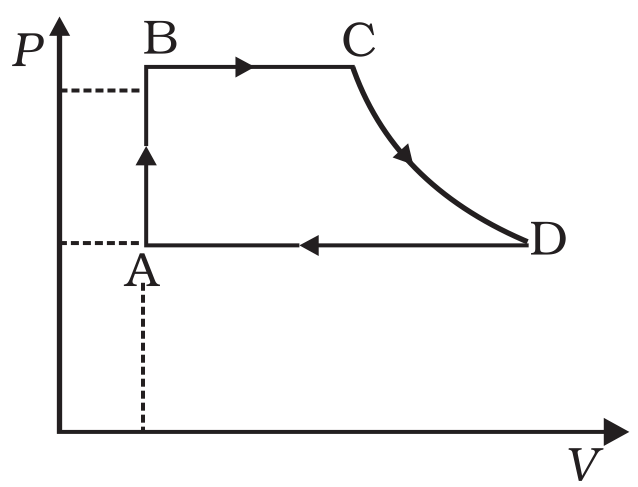
A cycle followed by an engine (made of one mole of an ideal gas in a cylinder with a piston) is shown in Fig. Find heat exchanged by the engine, with the surroundings for each section of the cycle. (Cv = (3/2) R)

AB : constant volume

BC : constant pressur

CD : adiabati

DA : constant pressure

Explain why friction is necessary to make the disc in roll in the direction indicated.
  1. Give the direction of frictional force at B, and the sense of frictional torque, before perfect rolling begins.
  2. What is the force of friction after perfect rolling begins?
A particle of mass m moving with an initial velocity u collides in elastically with a particle of mass M initially at rest. If the collision is completely inelastic, then find expressions for:
  1. Final velocity of combined entity and
  2. Loss in kinetic energy during collision.
Calculate the total energy of a satellite and define binding energy.
Calculate the number of degrees of freedom of molecules of hydrogen in 1cc of hydrogen gas at NTP.
A satellite is projected vertically upwards from an earth station. At what height above the earth's surface will the force on the satellite due to the earth be reduced to half its value at the earth station? (Radius of the earth is 6400km.)
(i) Whatement is position vector $\cos ^2 \alpha+\cos ^2 \beta+\cos ^2 \gamma=1$(ii) Explain the displacvector
Find the mass, the kinetic energy and the momentum of an electron moving at O.8c.
What do you mean by elastic collision? For an elastic head on collision, find expressions for final velocities of the bodies after collision.
Two discs of moments of inertia I1 and I2 about their respective axes (normal to the disc and passing through the centre), and rotating with angular speeds $\omega_1$ and $\omega_2$ are brought into contact face to face with their axes of rotation coincident.
  1. What is the angular speed of the two-disc system?
  2. Show that the kinetic energy of the combined system is less than the sum of the initial kinetic energies of the two discs. How do you account for this loss in energy? Take $\omega_1\neq\omega_2$