Question
Calculate the temperature at which the root mean square velocity of nitrogen molecules will be equal to $8km-s^{-1}$.

Answer

Given, r.m.s. velocity, $C = 8km-s^{-1} = 8 \times 10^5cm-s^{-1}$ Molar gas constant $= R = 8.31 \times 10^7erg ~mol^{-1}K^{-1}$ Molecular weight of nitrogeru M = 28 Let T be the required temperature Then, $\text{C}=\sqrt{\frac{3\text{RT}}{\text{M}}}$ or $\text{C}^2=\frac{3\text{RT}}{\text{M}}$ or $\text{T}=\frac{\text{MC}^2}{3\text{R}}$$=\frac{28\times(8\times10^5)^2}{3\times8.31\times10^7}\text{K}=71881\text{K}$

Need a full question paper?

Generate a complete, print-ready paper with questions like this in minutes — across 16+ boards, with answer keys.
Start Generating Free

Similar questions

Calculate the efficiency of a Carnot's engine working between steam point and ice point.
Galileo's law of odd numbers: "The distances traversed, during equal intervals of time, by a body falling from rest, stand to one another in the same ratio as the odd numbers beginning with unity [namely. 1: 3: 5: 7.......]" Prove it.
A nonconducting sheet of large surface area and thickness d contains uniform charge distribution of density $\rho.$ Find the electric field at a point P inside the plate, at a distance x from the central plane. Draw a qualitative graph of E against x for 0 < x < d.
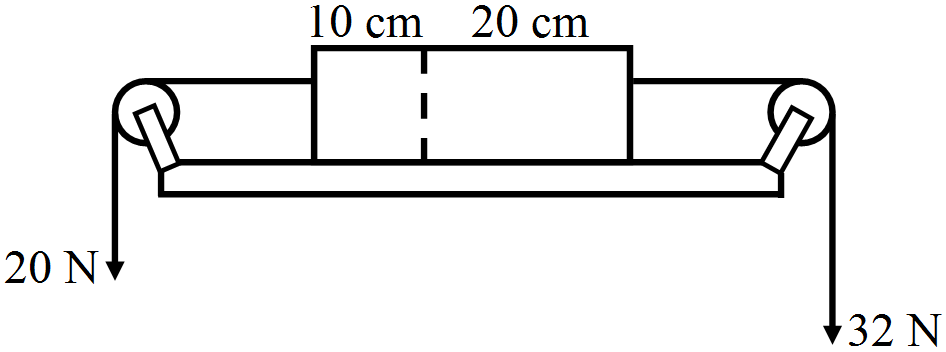
Figure shows a uniform rod of length $30cm$ having a mass of $3.0kg$. The strings shown in the figure are pulled by constant forces of $20N$ and $32N$. Find the force exerted by the $20cm$ part of the rod on the $10cm$ part. All the surfaces are smooth and the strings and the pulleys are light.
The horizontal range of cannon ball is $R$. If the greatest heights of two paths, for which this is possible, are $h$ and $h ^{\prime}$ then prove that
$4 \sqrt{h h^{\prime}}=R$
Calculate the change in energy of a $500kg$ satellite when it falls from an altitude of $200km$ to $199km$. If this change takes place during one orbit, calculate the retarding force on the satellite. [Given : mass of earth = $6 \times 10^{24}kg$ and radius of earth = $6400km$]
Water is filled in a rectangular tank of size $3m \times 2m \times 1m$.
  1. Find the total force exerted by the water on the bottom surface of the tank.
  2. Consider a vertical side of area $2m \times 1m$. Take a horizontal strip of width $ox$ metre in this side, situated at a depth of $x$ metre from the surface of water. Find the force by the water on this strip.
  3. Find the torque of the force calculated in part.$(b)$ about the bottom edge of this side.
  4. Find the total force by the water on this side.
  5. Find the total torque by the water on the side about.
The bottom edge. Neglect the atmospheric pressure and take $g = 10m/s^2$.
A vessel contains water upto a height of 20cm and above it an oil upto another 20cm. The refractive indices of the water and the oil are 1.33 and 1.30 respectively. Find the apparent depth of the vessel when viewed from above.
From the top of a tower $100m$ in height, a ball is dropped and at the same time another ball is projected vertically upwards from the ground with a velocity of $25ms^{-1}$. Find when and where the two balls will meet? $g = 9.8ms^{-2}​​​​​​​$?
A particle moves in a circle of radius $1.0\ cm$ at a speed given by $v = 2.0t$ where $v$ is in $cm/s$ and $t$ in seconds.
  1. Find the radial acceleration of the particle at $t = 1s.$
  2. Find the tangential acceleration at $t = 1s.$
  3. Find the magnitude of the acceleration at $t = 1s.$