Question
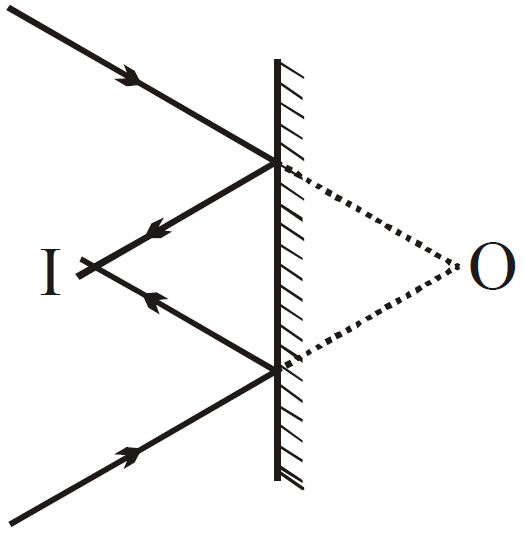
Can a plane mirror ever form a real image?

Answer

It object is virtual image is real.

Need a full question paper?

Generate a complete, print-ready paper with questions like this in minutes — across 16+ boards, with answer keys.
Start Generating Free

Similar questions

When a boron nucleus $\big(\text{ }^{10}_5\text{B}\big)$ is bombarded by a neutron, an $\alpha$-particle is emitted. Which nucleus will be formed as a result?
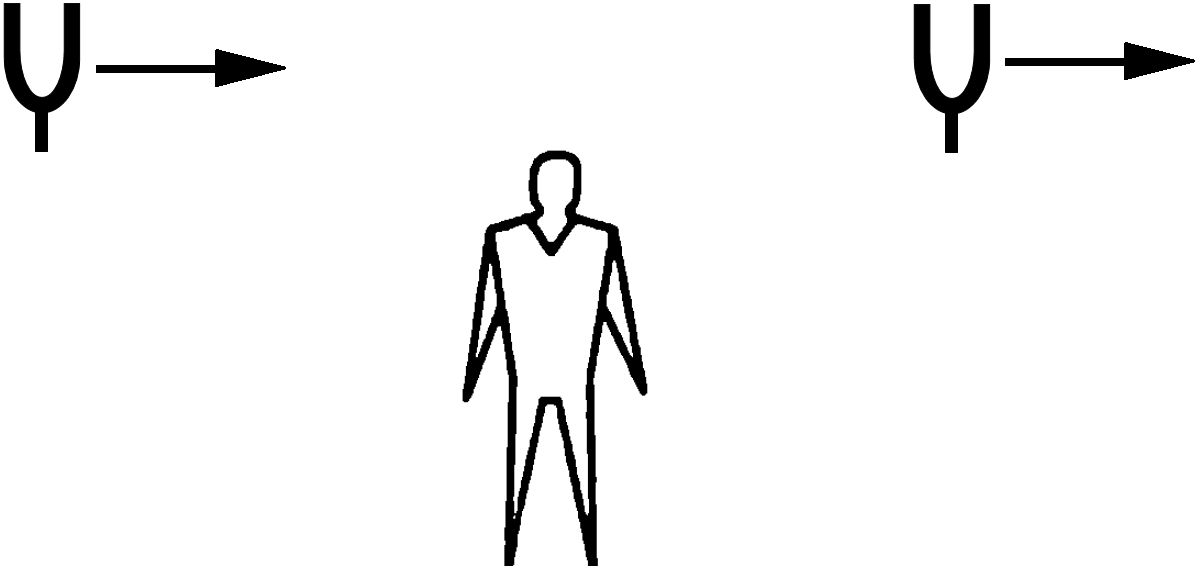
Figure, shows a person standing somewhere in between two identical tuning forks, each vibrating at $512\ Hz.$ If both the tuning fbrks move towards right at a speed of $5.5m/s,$ find the number of beats heard by the listener. Speed of sound in air $= 330m/s.$
Derive Einstein's Photoelectric equation.
In Exercises 7.3 and 7.4, what is the net power absorbed by each circuit over a complete cycle. Explain your answer.
Find the increase in energy of a condenser of capacity 6 µF on changing potential difference from 10 V to 20 V.
A cylindrical capacitor is constructed using two coaxial cylinders of the same length 10cm and of radii 2mm and 4mm:
  1. Calculate the capacitance.
  2. Another capacitor of the same length is constructed with cylinders of radii 4mm and 8mm. Calculate the capacitance.
Consider a circuit containing an ideal battery connected to a resistor. Do "work done by the battery" and "the thermal energy developed" represent two names of the same physical quantity?
Distinguish between ‘sky wave’ and ‘space wave’ modes of propagation. Why is the sky wave mode of propagation restricted to frequencies up to 40 MHz?
Two bar magnets are placed close to each other with their opposite poles facing each other. In absence of other force the magnets are pulled towards each other and their kinetic energy increases. Does it contradict our earher knowledge that magnetic forces cannot do any work and hence cannot increase kinetic energy of a system?
A molecule of a substance has a permanent electric dipole moment of magnitude $10^{-29} C m$. A mole of this substance is polarised (at low temperature) by applying a strong electrostatic field of magnitude $10^6 V m ^{-1}$. The direction of the field is suddenly changed by an angle of $60^{\circ}$. Estimate the heat released by the substance in aligning its dipoles along the new direction of the field. For simplicity, assume $100 \%$ polarisation of the sample.