Question
Can a process on an ideal gas be both adiabatic and isothermal?

Answer

No,
In a system either temperature varies or it heat varies.
In case of ideal gas Internal energy is function of temperature only thus for isothermal process change in internal energy is zero.
Now, since process is adiabatic thus heat exchange is zero.
therefore, work done is also zero.

Need a full question paper?

Generate a complete, print-ready paper with questions like this in minutes — across 16+ boards, with answer keys.
Start Generating Free

Similar questions

Monochromatic light entering from one medium to another, its wavelength changes but the frequency does not change, explain.
Explain the thermonuclear fusion from the fusion of helium atom in the interior of a star and the Red Giant of the Sun.
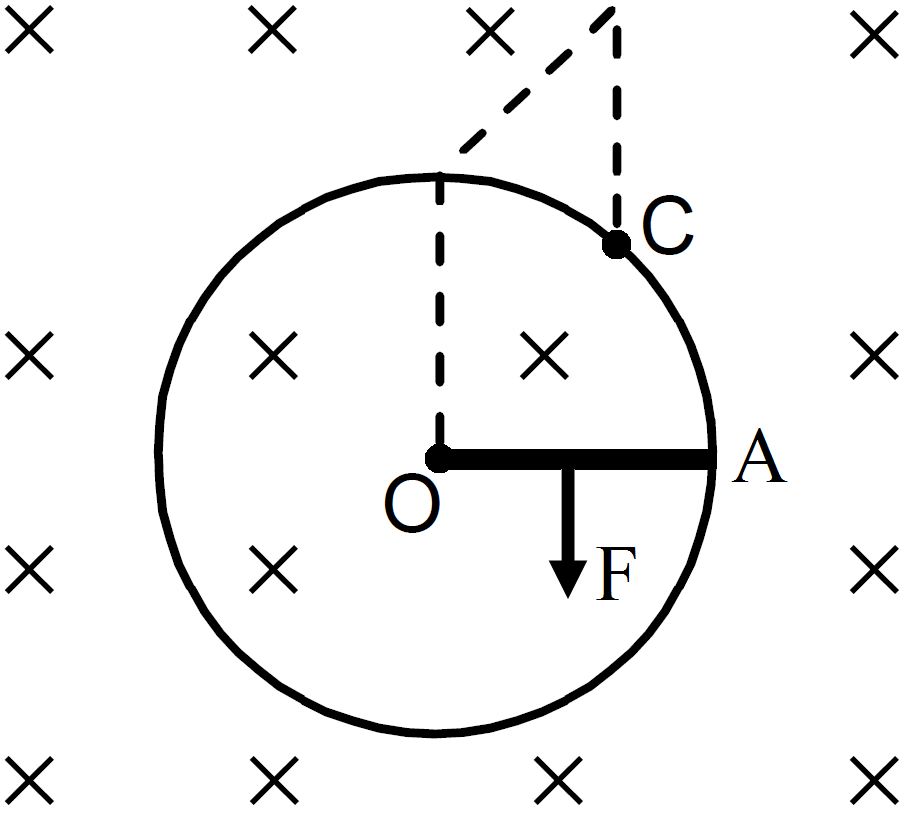
Figure shows a conducting circular loop of radius a placed in a uniform, perpendicular magnetic field B. A thick metal rod OA is pivoted at the centre O. The other end of the rod touches the loop at A. The centre O and a fixed point C on the loop are connected by a wire OC of resistance R. A force is applied at the middle point of the rod OA perpendicularly, so that the rod rotates clockwise at a uniform angular velocity $\omega.$ Find the force.
The voice of a person, who has inhaled helium, has a remarkably high pitch. Explain on the basis of resonant vibration of vocal cord filled with air and with helium.
Current of 0.5 A is flowing through a circular loop of radius 5 cm . Calculate the magnetic field at the center of the loop.
Draw a graph showing the variation of potential energy between a pair of nucleons as a function of their separation. Indicate the regions in which the nuclear force is. (i) attractive, (ii) repulsive.
The angle made by the string of a simple pendulum with the vertical depends on time as $\theta=\frac{\pi}{90}\sin[(\pi\text{s}^{-1})\text{t}].$ Find the length of the pendulum if $\text{g}=\pi^2\text{m/s}^2.$
The earth revolves round the sun because the sun attracts the earth. The sun also attracts the moon and this force is 'about twice as large as the attraction of the earth on the moon. Why does the moon not revolve round the sun? Or does it?
Show that the equipotential surfaces are closed together in the regions of strong field and far apart in the regions of weak field. Draw equipotential surfaces for an electric dipole.
An $\alpha$–particle and a proton are moving in the plane of paper in a region where there is a uniform magnetic field directed normal to the plane of the paper. If the particles have equal linear momenta, what would be the ratio of the radii of their trajectories in the field?