Question
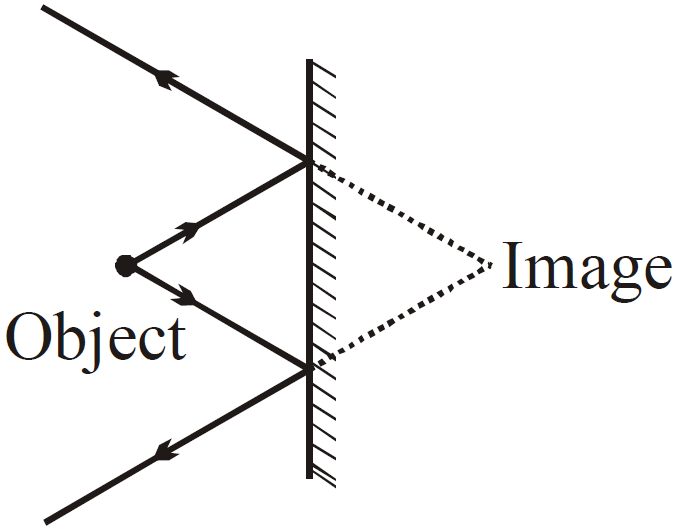
Can a virtual image be photographed by a camera?
Answer


Yes, when you stand in front of plane mirror image is virtual and can be photographed.

Need a full question paper?

Generate a complete, print-ready paper with questions like this in minutes — across 16+ boards, with answer keys.

Start Generating Free

Similar questions

An electric dipole of length I cm, which placed with its axis making an angle of $60^{\circ}$with uniform electric field, experiences a torque of $6\sqrt{3}$ Nm. Calculate the potential energy of the dipole if it has charge $\pm$ 2 nC.
The separation between a node and the next antinode in a vibrating air column is 25cm. If the speed of sound in air is 340m/s, find the frequency of vibration of the air column.
A convex lens (n = 1.5) of focal length fa is immersed.
  1. In water n = 1.33 and.
  2. In carbon disulphide n = 1.6, how does the lens behave in the two cases?
The lower end of a capillary tube is immersed in mercury. The level of mercury in the tube is found to be 2cm below the outer level. If the same tube is immersed in water, upto what height will the water rise in the capillary?
A U- tube containing a liquid is accelerated horizontally with a constant acceleration a0. If the separation between the vertical limbs is 1, find the difference in the heights of the liquid in the two arms.
Two point charges, q1 = 10 × 10–8 C and q2 = – 2 × 10⁻⁸ C are separated by a distance of 60 cm in air.
  1. Find at what distance from the 1st charge, q1 would the electric potential be zero.
  2. Also calculate the electrostatic potential energy of the system.
Consider two particles A and B having equal charges and placed at some distance. The particle A is slightly displaced towards B. Does the force on B increase as soon as the particle A is displaced? Does the force on the particle A increase as soon as it is displaced?
A lamp attached to a cycle glows by a dynamo. When cycle is moved at greater speed, the lamp glows brightly and when cycle moves with a lesser speed, it glows dimly. Why?
The potential difference between the terminals of a 6.0V battery is 7.2V when it is being charged by a current of 2.0A. What is the internal resistance of the battery?
Answer the following questions:
In any ac circuit, is the applied instantaneous voltage equal to the algebraic sum of the instantaneous voltages across the series elements of the circuit? Is the same true for rms voltage?