Question
Can alternating current cause electrolysis?

Answer

No, because alternating current changes periodically whereas for the process of electrolysis, the magnitude nad direction of current does not change with time.

Need a full question paper?

Generate a complete, print-ready paper with questions like this in minutes — across 16+ boards, with answer keys.

Start Generating Free

Similar questions

Definition of electric field intensity at a point.
Two alternating currents are given by, $\text{i}_\text{i}=\text{i}_0\sin\omega\text{t}$ and $\text{i}_\text{i}=\text{i}_0\sin\Big(\omega\text{t}+\frac{\pi}{3}\Big)$ Will the $\text{rms}$ values of the currents be equal or different?
What is the direction of the electric dipole moment vector quantity?
When a body is weighed on an ordinary balance we demand that the arm should be horizontal if the weights on the two pans are equal. Suppose equal weights are put on the two pans, the arm is kept at an angle with the horizontal and released. Is the torque of the two weights about the middle point (point of support) zero? Is the total torque zero? If so, why does the arm rotate and finally become horizontal?
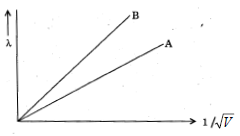
Two lines, A and B, in the plot given below show. the variation of de Broglie wavelength, $\lambda$ versus $1/\sqrt{\text{V}},$ where V is the accelerating potential difference, for two particles carrying the same charge. Which one of two represents a particle of smaller mass?
Write relation between magnetic induction B, magnetic field H and intensity of magnetisation I.
If the self-inductance of an iron core inductor increases from 0·01mH to 10mH on introducing the iron core into it, what is the relative permeability of the core material used?
Define the term ‘dielectric constant’ of a medium in terms of capacitance of a capacitor.
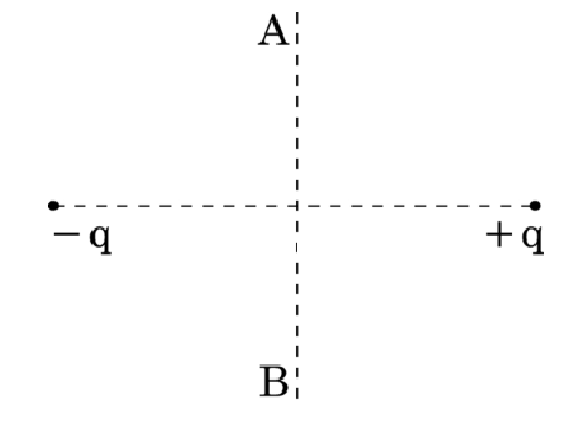
A charge $'q\ '$ is moved from a point $A$ above a dipole of dipole moment $'p\ '$ to a point $B$ below the dipole in equatorial plane without acceleration. Find the work done in the process.
Which of the statements is true for p-type semiconductos.
  1. Electrons are majority carriers and trivalent atoms are the dopants.
  2. Electrons are minority carriers and pentavalent atoms are the dopants.
  3. Holes are minority carriers and pentavalent atoms are the dopants.
  4. Holes are majority carriers and trivalent atoms are the dopants.