Question
Can alternating galvanometer measure both alternating and direct currents?

Answer

Yes, because it works on principle of heating effect.

Need a full question paper?

Generate a complete, print-ready paper with questions like this in minutes — across 16+ boards, with answer keys.
Start Generating Free

Similar questions

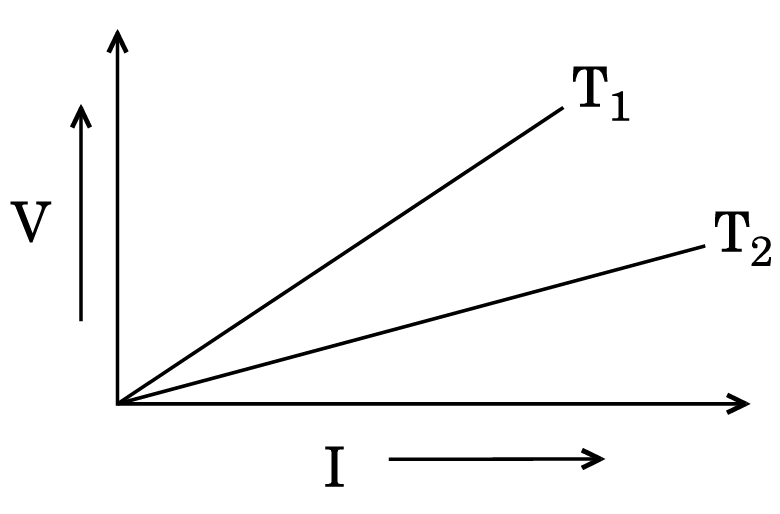
V – I graph for a metallic wire at two different temperatures $T_1$ and $T_2$ is as shown in the figure. Which of the two temperatures is higher and why?
Show that the minimum energy needed to separate a proton from a nucleus with Z protons and N neutrons is:
$\Delta\text{E}=(\text{M}_{\text{Z}-1,\text{N}}+\text{M}_{\text{H}}-\text{M}_{\text{Z,N}})\text{c}^2$
where $M_{\text{Z,N}}=$ mass of an atom with Z protons and N neutrons in the nucleus and $M_H=$ mass of a hydrogen atom. This energy is known as proton-separation energy.
What is find by using the Huygens' principle?
A room is illuminated by an extended source. The illuminance at a particular portion of a wall can be increased by:
  1. Moving the source.
  2. Rotating the source.
  3. Bringing some mirrors in proper positions.
  4. Changing the colour of the source.
Can a metal sphere of radius one meter be given a charge of 1 coulomb?
What is the height of the final image of the tower if it is formed at 25cm?
A particle executes simple harmonic motion. Let P be a point near the mean position and Q be a point near an extreme. The speed of the particle at P is larger than the speed at Q. Still the particle crosses P and Q equal number of times in a given time interval. Does it make you unhappy?
Two converging lenses of unequal focal lengths can be used to reduce the aperture of a parallel beam of light without losing the energy of the light. This increases the intensity. Describe how the converging lenses should be placed to do this.
When a tiny circular obstacle is placed in the path of light from a distant source, a bright spot is seen at the center of the shadow of the obstacle. Explain why.
Do two distinct poles actually exist at two nearby points in a magnetic dipole?