Question
Can an electromagnetic wave be polarised?

Answer

An electromagnetic wave is a transverse wave, thus, it can be polarised. An unpolarised wave consists of many independent waves, whose planes of vibrations of electric and magnetic fields are randomly oriented. They are polarised by restricting the vibrations of the electric field vector or magnetic field vector in one direction only.
Need a full question paper?

Generate a complete, print-ready paper with questions like this in minutes — across 16+ boards, with answer keys.

Start Generating Free

Similar questions

A wheel rotating at a speed of 600rpm (revolutions per minute) about its axis is brought to rest by applying a constant torque for 10 seconds. Find the angular deceleration and the angular velocity 5 seconds after the application of the torque.
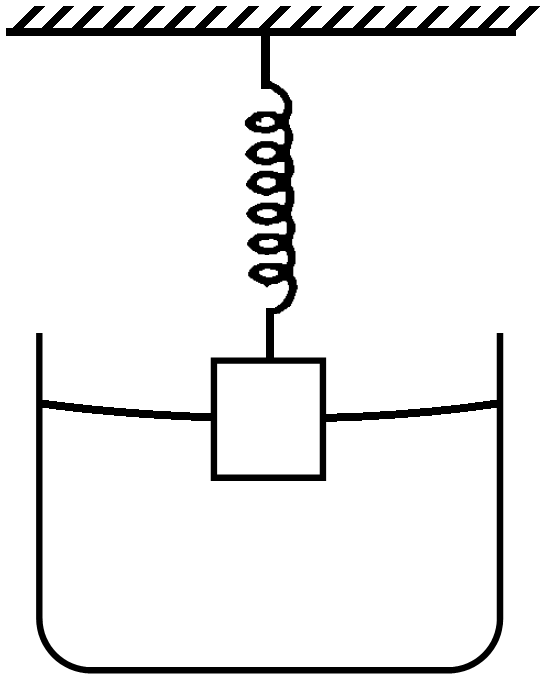
A cylindrical object of outer diameter 10cm, height 20cm and density 8000kg/m3 is supported by a vertical spring and is half dipped in water as shown in.
  1. Find the elongation of the spring in equilibrium condition.
  2. If the object is slightly depressed and released, find the time period of resulting oscillations of the object. The spring constant = 500N/m.

The sufrace tension and vapour pressure of water at 20°C is 7.28 × 10⁻²N m-1 and 2.33 × 10³ Pa, respectively. What is the radius of the smallest spherical water droplet which can form without evaporating at 20°C?
A car moving with a speed of 50km/ h-1 can be stopped by brakes after at least 6m. What will be the minimum stopping distance, if the same car is moving at a speed of 100km/ h-1?
A new unit of length is chosen such that the speed of light in vacuum is unity. What is the distance between the Sun and the Earth in terms of the new unit if light takes 8min and 20s to cover this distance?
A 3cm tall object is placed at a distance of 7.5cm from a convex mirror of focal length 6cm. Find the location, size and nature of the image.
A transformer has 50 turns in the primary and 100 in the secondary. If the primary is connected to a 220V DC supply, what will be the voltage across the secondary?
A railway car of mass 20 tonnes moves with an initial speed of $54 km / hr$. On applying brakes, a constant negative acceleration of $0.3 m / s ^2$ is produced.
i. What is the breaking force acting on the car?
ii. In what time it will stop?
iii. What distance will be covered by the car before it finally stops?
The weight of a body on the surface of earth is 250N. Calculate its weight at distance equal to half of the radius of earth below the surface of earth. (Radius of earth = 6400km).
What are the energies involved in streamline flow of ideal liquid? Explain briefly.