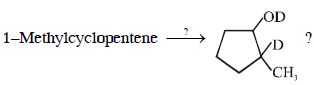
MCQ
can be
  • A
    dil. $D_2SO_4$
  • B
    $\xrightarrow[{2.NaB{D_4}}]{{1.Hg\,{{(OAc)}_2},{D_2}O}}$
  • C
    $\xrightarrow[{2.{D_2}O,AcOD}]{{1.{B_2}{D_6}}}$
  • $\xrightarrow[{2.{D_2}{O_2},NaOD}]{{1.{B_2}{D_6}}}$
Answer

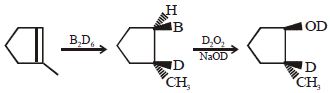
Correct option: D.
$\xrightarrow[{2.{D_2}{O_2},NaOD}]{{1.{B_2}{D_6}}}$
d

Need a full question paper?

Generate a complete, print-ready paper with questions like this in minutes — across 16+ boards, with answer keys.

Start Generating Free

Similar questions

The gas phase reaction

$2 A ( g ) \rightleftharpoons A _{2}( g )$

at $400\, K$ has $\Delta G ^{\circ}=+25.2\, kJ mol ^{-1}$.

The equilibrium constant $K _{ C }$ for this reaction is $...... \times 10^{-2}$. (Round off to the Nearest integ $\left[\right.$ Use $: R=8.3\, J mol ^{-1} K ^{-1}, \ln 10=2.3$

$\left.\log _{10} 2=0.30,1\, atm =1\, bar \right]$

$[$ antilog $(-0.3)=0.501]$

The calculated spin only magnetic moments $(BM)$ of the anionic and cationic species of ${\left[ {Fe{{\left( {{H_2}O} \right)}_6}} \right]_2}$ and $\left[ {Fe{{\left( {CN} \right)}_6}} \right]$ , respectively, are:
Which one of the following ionic species has the greatest proton affinity to form stable compound ?
Excess of $aq. NH_3$ can dissolve
Consider the following complex : $[Co(NH_3)_5CO_3]ClO_4$ The coordination  number, oxidation number, no. of $d-$ electrons and number of unpaired $d-$ electrons  on the metal are respectively
Assertion :The cell potential of mercury cell is $1.35\,V$, which remains constant.

Reason : In mercury cell, the electrolyte is a paste of $KOH$ and $ZnO$.

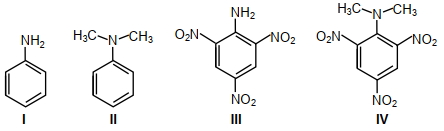
Consider the following four compounds $I, II, III,$ and $IV$.

Choose the correct statement($s$).

$(A)$ The order of basicity is $II > I > III > IV$ .

$(B)$ The magnitude of $p K_{ b }$ difference between $I$ and $II$ is more than that between $III$ and $IV$.

$(C)$ Resonance effect is more in $III$ than in $IV$.

$(D)$ Steric effect makes compound $IV$ more basic than $III$.
Among the following compounds the one that is most reactive towards electrophilic nitration is
What is the separation energy (in $eV$ ) for $Be^{3+}$ in the first excited state in ...............  $\mathrm{eV}$ ?
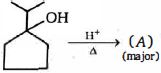
Product $(A)$ is