Question
Can electric potential at a point be zero, while the electric field is not zero?

Answer

Yes, electric potential is zero at all points on equatorial line of electric dipole, while electric field strength is not zero.

Need a full question paper?

Generate a complete, print-ready paper with questions like this in minutes — across 16+ boards, with answer keys.
Start Generating Free

Similar questions

What is the frequency of electromagnetic waves originated from oscillating electrical circuits?
In a rotating body, $\text{a}=\alpha\text{r}$ and $\text{v}=\omega\text{r}.$ Thus $\frac{\text{a}}{\alpha}=\frac{\text{v}}{\omega}.$ Can a co you use the theorems of ratio and proportion studied in algebra so as to write$\frac{\text{a}+\alpha}{\text{a}-\alpha}=\frac{\text{v}+\omega}{\text{v}-\omega}$
Two point charges are placed at a distance d from each other. Due to these, the electric field intensity at any point is zero. But the point is not in the middle of these charges although on the line connecting them, write two necessary conditions for this to happen.
The velocity of a particle is towards west at an instant. Its acceleration is not towards west, not towards east, not towards north and not towards south. Give an example of this type of motion.
A bullet of mass 20g enters into a fixed wooden block with a speed of $40ms^{-1}$ and stops in it. Find the change in internal energy during the process.
The susceptibility of a magnetic material is 0.9853. Identify the type of magnetic material. Draw the modification of the field pattern on keeping a piece of this material in a uniform magnetic field.
Name the part of electromagnetic spectrum whose wavelength lies in the range of $10^{-10} \mathrm{~m}$. Give its one use.
What will be the effect on the focal length of a convex lens ( $n=1.5$ ) when it is immersed in water?
Should a thermometer bulb have large heat capacity or small heat capacity?
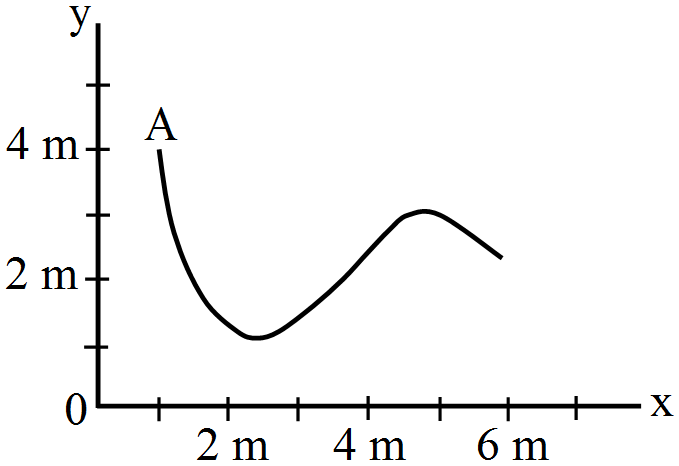
A particle starts from a point A and travels along the solid curve shown in figure. Find approximately the position B of the particle such that the average velocity between the positions A and B has the same direction as the instantaneous velocity at B.