Question
Can normal force do a nonzero work on an object. If yes, give an example. If no, give reason.

Answer

Yes. Let us consider an elevator accelerating upward with a body placed in it. In this case, the normal reaction offered by the floor of the elevator on the body is greater than the weight of the body acting in the downward direction. If a person is observing this from the ground, then, for him, the normal reaction is doing a positive work, as the elevator is moving upward.

Need a full question paper?

Generate a complete, print-ready paper with questions like this in minutes — across 16+ boards, with answer keys.
Start Generating Free

Similar questions

The magnetic field at a point inside a 2.0mH inductor coil becomes 0.80 of its maximum value in 20µs when the inductor is joined to a battery. Find the resistance of the circuit.
Explain giving reasons for the following:
  1. Photoelectric current in a photocell increases with the increase in the intensity of the incident radiation.
  2. The stopping potential $(V_0)$ varies linearly with the frequency $(v)$ of the incident radiation for a given photosensitive surface with the slope remaining the same for different surfaces.
  3. Maximum kinetic energy of the photoelectrons is independent of the intensity of incident radiation.
A monochromatic light source of intensity $6\ mW$ emits $8 \times 10^{16}$ photons per second. This light ejects photoelectrons from a metal surface. The stopping potential for this setup is $2.0V.$ Calculate the work function of the metal.
It is sometimes heard that inertial frame of reference is only an ideal concept and no such inertial frame actually exists. Comment.
Light of wavelength $488\ nm$ is produced by an argon laser which is used in the photoelectric effect. When light from this spectral line is incident on the emitter, the stopping $($cut$-$off$)$ potential of photoelectrons is $0.38 V.$ Find the work function of the material from which the emitter is made.
If mercury and glass had equal coefficient of volume expansion, could we make a mercury thermometer in a glass tube?
  1. In Young's double slit experiment, two slits are $1\ mm$ apart, and the screen is placed $1m$ away from the slits. Calculate the fringe width when light of wavelength $500\ nm$ is used.
  2. What should be the width of each slit in order to obtain $10$ maxima of the double slits pattern within the central maximum of the single slit pattern?
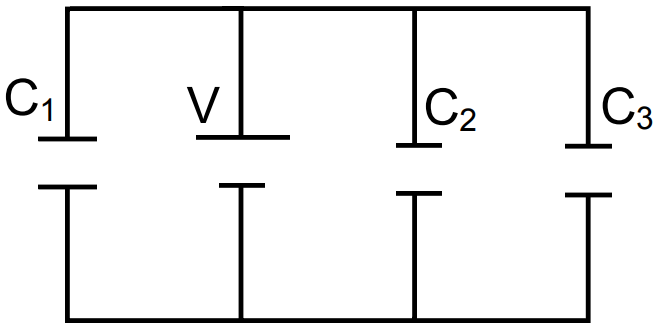
Find the charges on the three capacitors connected to a battery as shown in figure. Take $\text{C}_1=2.0\mu\text{F},\ \text{C}_2=4.0\mu\text{F},\ \text{C}_3=6.0\mu\text{F}$ and V = 12 volts.
A light of wavelength 6000 Å is incident on a metal of work function 2 eV. Will electrons be emitted? If yes, find maximum energy of emitted electrons.
Give brief explanation of a semi-conductor diode.