Question
Can the potential energy in a simple harmonic motion be negative? Will it be so if we choose zero potential energy at some point other than the mean position?

Answer

No. It cannot be negative because the minimum potential energy of a particle executing simple harmonic motion at mean position is zero. The potential energy increases in positive direction at the extreme position.
However, if we choose zero potential energy at some other point, say extreme position, the potential energy can be negative at the mean position.

Need a full question paper?

Generate a complete, print-ready paper with questions like this in minutes — across 16+ boards, with answer keys.
Start Generating Free

Similar questions

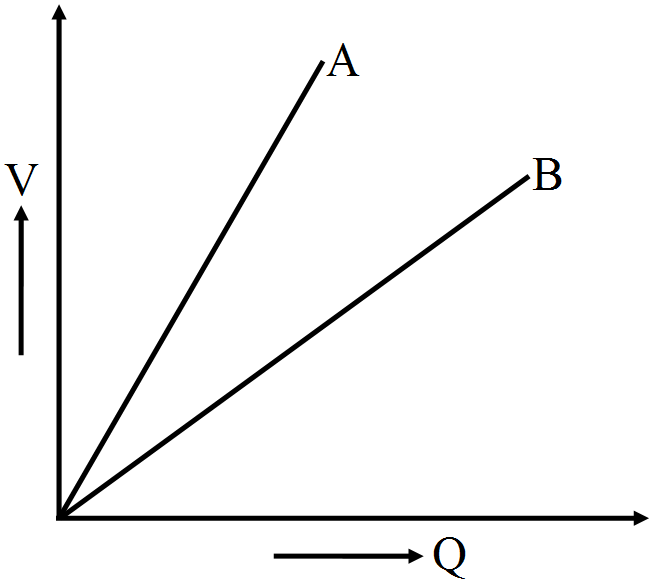
The graph shows the variation of voltage ‘V’ across the plates of two capacitors A and B versus increase of charge ‘Q’ stored on them. Which of the two capacitors has higher capacitance? Give reason for your answer.
A capacitor of capacity C is charged with a potential difference V. What will be the value of electric flux passing through the surface around the capacitor?
A gas is kept in a rigid cubical container. If a load of 10kg is put on the top of the container, does the pressure increase?
Current obtained from a choke coil of 2 henry is decreasing at the rate of $5 A / s$. Calculate the electromotive force developed across the ends of the coil.
Answer carefully:
If Coulomb’s law involved $\frac{1}{\text{r}^{3}}$ dependence $(\text{instead of}\ \frac{1}{\text{r}^{2}})$, would Gauss’s law be still true?
Can the peak voltage across the inductor be greater than the peak voltage of the source in an LCR circuit?
When a semiconducting material is doped with an impurity, new acceptor levels are created. In a particular thermal collision, a valence electron receives an energy equal to 2kT and just reaches one of the acceptor levels. Assuming that the energy of the electron was at the top edge of the valence band and that the temperature T is equal to 300K, find the energy of the acceptor levels above the valence band.
Nichrome and copper wires of same length and same radius are connected in series. Current I is passed through them. Which wire gets heated up more? Justify your answer.
Why can't we see clearly through fog? Name the phenomenon responsible for it.
Sketch a graph showing variation of resistivity of carbon with temperature.