Question
Can the potential function have a maximum or minimum in free space?

Answer

No, the potential function does not have a maximum or minimum in free space, it is because the absence of atmosphere around conductor prevents the phenomenon of electric discharge or potential leakage.

Need a full question paper?

Generate a complete, print-ready paper with questions like this in minutes — across 16+ boards, with answer keys.

Start Generating Free

Similar questions

The electric foree between two electric charges in a medium is F . The distance between them is $d$. At what distance were they placed from each other
so that the electric foree becomes (i) 3 F (ii) $\frac{ F }{4}$ ?
State Biot-Savart law.

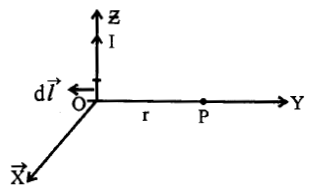
A current I flows in a conductor placed perpendicular to the plane of the paper.Indicate the direction of the magnetic field due to a small element d $\overrightarrow{l}$at point P situated at a  distance $ \overrightarrow{r}$ from the element as shown in the figure.

How does the power of a convex lens vary, if the incident red light is replaced by violet light?
The light emitted in the transition n = 3 to n = 2 in hydrogen is called $\text{H}_\alpha$ light. Find the maximum work function a metal can have so that $\text{H}_\alpha$ light can emit photoelectrons from it.
If the radius of a copper wire is doubled, will its specific resistance increase, decrease or remain same?
Write any three characteristics, a ferromagnetic substance should possess if it is to be used to make a permanent magnet. Give one example of such a material.
A series LCR circuit with R = 20 Ω L = 1.5 H and $C=35 \mu F$ is connected to a variable frequency 200 V ac supply. When the frequency of the supply equals the natural frequency of the circuit, what is the average power transferred to the circuit in one complete cycle?
A copper wire of cross-sectional area 0.01cm2 is under a tension of 20N. Find the decrease in the cross-sectional area. Young's modulus of copper = 1.1 × 10 11N/m2 and Poisson's ratio = 0.32.

$\Big[$Hint: $\frac{\triangle\text{A}}{\text{A}}=2\frac{\triangle\text{r}}{\text{r}}\Big]$

Let $\vec{\text{A}}=3\vec{\text{i}}+4\vec{\text{j}}.$ Write four vector $\overrightarrow{\text{B}}$ such that $\overrightarrow{\text{A}}\neq\overrightarrow{\text{B}}$ but A = B.
Which physical quantities are conserved in natural and artificial radioactivity?