Question
Can the resultant of $2$ vectors be zero

Answer

Yes, when the $2$ vectors are same in magnitude but opposite in sense

Need a full question paper?

Generate a complete, print-ready paper with questions like this in minutes — across 16+ boards, with answer keys.
Start Generating Free

Similar questions

The air density at Mount Everest is less than that at the sea level. It is found by mountaineers that for one trip lasting a few hours, the extra oxygen needed by them corresponds to $30,000\ cc$ at sea level (pressure $1$ atmosphere, temperature $27^oC).$ Assuming that the temperature around Mount Everest is $-73^oC$ and that the oxygen cylinder has capacity of $5.2\ litre,$ the pressure at which $O_2$ be filled (at site) in cylinder is ..... $atm$
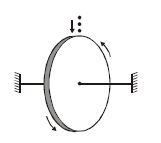
A uniform disc of mass $m_0$ rotates freely about a fixed horizontal axis passing through its centre. A thin cotton pad is fixed to its rim, which can absorb water. The mass of water dripping onto the pad per unit time is $\mu.$ After what time will the angular velocity of the disc get reduced to half its initial value ?
It is found that if a neutron suffers an elastic collinear collision with deuterium at rest, fractional loss of its energy is $p_d $ ; while for its similar collision with carbon nucleus at rest, fractional loss of energy is $P_c$. The values of $P_d$ and $P_c$ are respectively
A charge of $10\, e.s.u.$ is placed at a distance of $2\, cm$ from a charge of $40\, e.s.u.$ and $4\, cm$ from another charge of $20\, e.s.u.$ The potential energy of the charge $10\, e.s.u.$ is (in $ergs$)
In a parallel plate condenser, the radius of each circular plate is $12\,cm$ and the distance between the plates is $5\,mm$. There is a glass slab of $3\,mm$ thick and of radius $12\,cm$ with dielectric constant $6$ between its plates. The capacity of the condenser will be
A particle is projected from the ground with velocity $u$ at angle $\theta$ with horizontal. The horizontal range, maximum height and time of flight are $R, H$ and $T$ respectively. They are given by $R = \frac{{{u^2}\sin 2\theta }}{g}$, $H = \frac{{{u^2}{{\sin }^2}\theta }}{{2g}}$ and $T = \frac{{2u\sin \theta }}{g}$  Now keeping $u $ as fixed, $\theta$ is varied from $30^o$ to $60^o$. Then,
Wave nature of light cannot explain photoelectric effect because in photoelectric effect, it is seen that
In the given reaction :

$\begin{array}{*{20}{c}}
  O \\ 
  {||} \\ 
  {C{H_3} - C - C{H_3}} 
\end{array}\mathop {\xrightarrow{{Conc.{H_2}S{O_4}}}}\limits_{Distillation} [X]$

$[X]$ will be :

Two satellites $A$ and $B$ go round a planet $ P$ in circular orbits having radii $4R$ and $R$ respectively. If the speed of the satellite $A$ is $3V$, the speed of the satellite $B$ will be ........ $V$
In a toroid the number of turns per unit length is $1000$ and current through it is $\frac{1}{4 \pi}$ ampere. The magnetic field produced inside (in $weber / m ^2$ ) will be