Question
Can there be a potential difference between two adjacent conductors carrying the same charge?

Answer

In a uniform electric field, free electrons move opposite to the direction of electric field.
As the electric field is always direct from higher potential to lower travel so, electrons move from lower potential to higher potential.

Need a full question paper?

Generate a complete, print-ready paper with questions like this in minutes — across 16+ boards, with answer keys.
Start Generating Free

Similar questions

The de Broglie wavelengths, associated with a proton and a neutron, are found to be equal. Which of the two has a higher value for kinetic energy?
A ray of light, incident on an equilateral glass prism$(\mu_{g} = \sqrt{3})$ moves parallel to the base line of the prism inside it. Find the angle of incidence for this ray.
A source emits 31.4W of radiant flux distributed uniformly in all directions. The luminous efficiency is 60 lumen/ watt. What is the luminous intensity of the source?
Lattice structure of $C , Si$ and Ge is similar. Still, why is C an insulator while Si and Ge are intrinsic semiconductors?
The peak power consumed by a resistive coil, when connected to an AC source, is 80W. Find the energy consumed by the coil in 100 seconds, which is many times larger than the time period of the source.
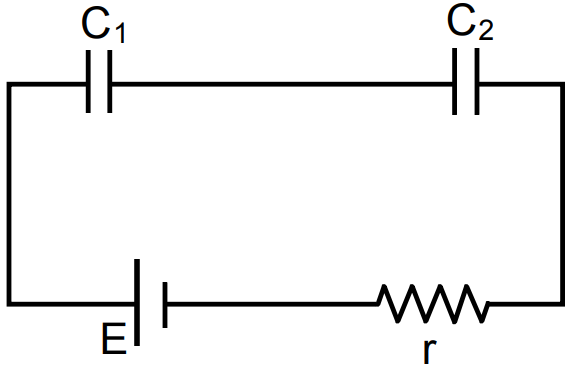
Consider the situation shown in figure. The switch is closed at t = 0 when the capacitors are uncharged. Find the charge on the capacitor $C_1$ as a function of time t.
A hydrogen atom in a state having a binding energy of 0.85eV makes transition to a state with excitation energy 10.2eV (a) Identify the quantum numbers n of the upper and the lower energy states involved in the transition. (b) Find the wavelength of the emitted radiation.
Two satellites going in equatorial plane have almost same radii. As seen from the earth one moves from east to west and the other from west to east. Will they have the same time period as seen from the earth? If not, which one will have less time period?
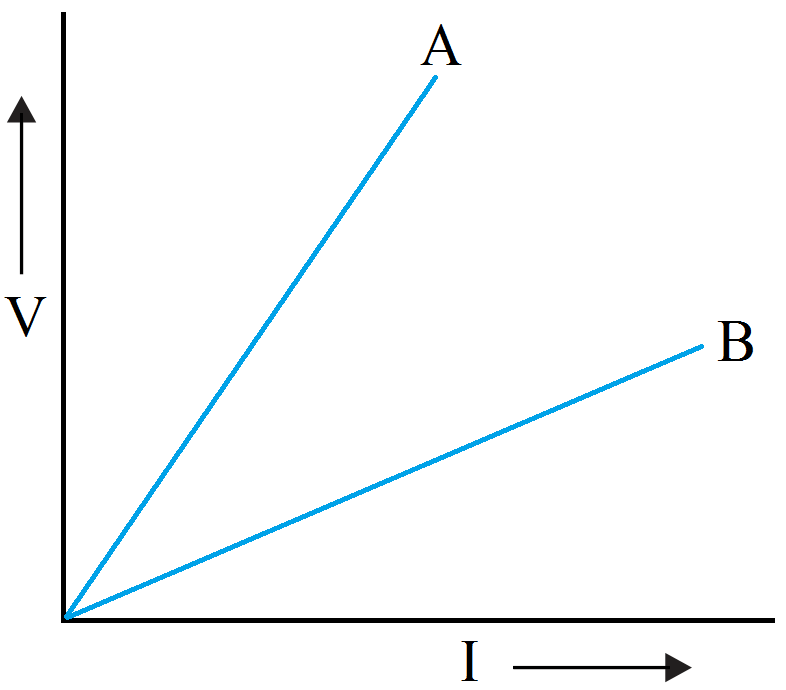
V-I graphs for parallel and series combinations of two metallic resistors are shown in figure. Which graph represents parallel combination? Justify your answer.
A steel rod is clamped at its two ends and rests on a fixed horizontal base. The rod is unstrained at $20^\circ C$. Find the longitudinal strain developed in the rod if the temperature rises to $50^\circ C$. Coefficient of linear expansion of steel $= 1.2 \times 10^{-5} $$^\circ C^{-1}.$