Question
Can two equipotential surfaces cut each other?

Answer

At the point of intersection, two normals can be drawn. Also, we know that electric field lines are perpendicular to the equipotential surface. This implies that at that point two different directions of the electric field are possible, which is not possible physically.
Hence, two equipotential surfaces cannot cut each other.

Need a full question paper?

Generate a complete, print-ready paper with questions like this in minutes — across 16+ boards, with answer keys.
Start Generating Free

Similar questions

What is the kinetic energy of an electron in electronvolts with mass equal to double its rest mass?
A long charged cylinder of linear charged density λ is surrounded by a hollow co-axial conducting cylinder. What is the electric field in the space between the two cylinders?
The wavelength of a probe is roughly a measure of the size of a structure that it can probe in some detail. The quark structure of protons and neutrons appears at the minute length-scale of $10^{–15}$ m or less. This structure was first probed in early 1970’s using high energy electron beams produced by a linear accelerator at Stanford, USA. Guess what might have been the order of energy of these electron beams. (Rest mass energy of electron = 0.511 MeV.)
A circular coil of radius 8.0cm and 20 turns is rotated about its vertical diameter with an angular speed of 50rad $s^{–1}$ in a uniform horizontal magnetic field of magnitude $3.0 \times 10^{–2}T.$ Obtain the maximum and average emf induced in the coil. If the coil forms a closed loop of resistance 10Ω, calculate the maximum value of current in the coil. Calculate the average power loss due to Joule heating. Where does this power come from?
Suppose while sitting in a parked car, you notice a jogger approaching towards you in the side view mirror of $R=2 m$. If the jogger is running at a speed of $5 m s ^{-1}$, how fast the image of the jogger appear to move when the jogger is (a) $39 m$, (b) $29 m$, (c) $19 m$, and (d) $9 m$ away.
A solenoid of length 1.0m, radius 1cm and total turns 1000 wound on it, carries a current of 5A. Calculate the magnitude of the axial magnetic field inside the solenoid. If an electron was to move with a speed of $104ms^{–1}$ along the axis of this current carrying solenoid, what would be the force experienced by this electron?
Prove that, if an insulated, uncharged conductor is placed near a charged conductor and no other conductors are present, the uncharged body must be intermediate in potential between that of the charged body and that of infinity.
Using Bohr's total postulates, derive the expression for the total energy of the electron in the stationary states of hydrogen atom.
Derive the formula for conductivity and resistivity of metals by obtaining the relationship between drift velocity and current density.

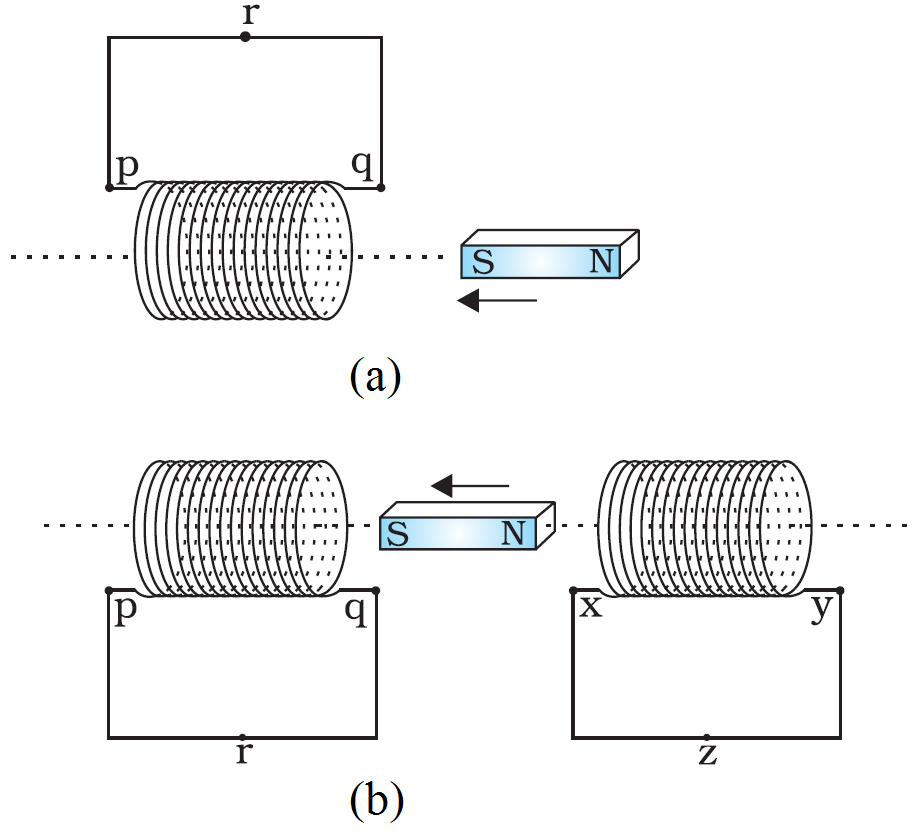
Predict the direction of induced current in the situations described in the following figs.